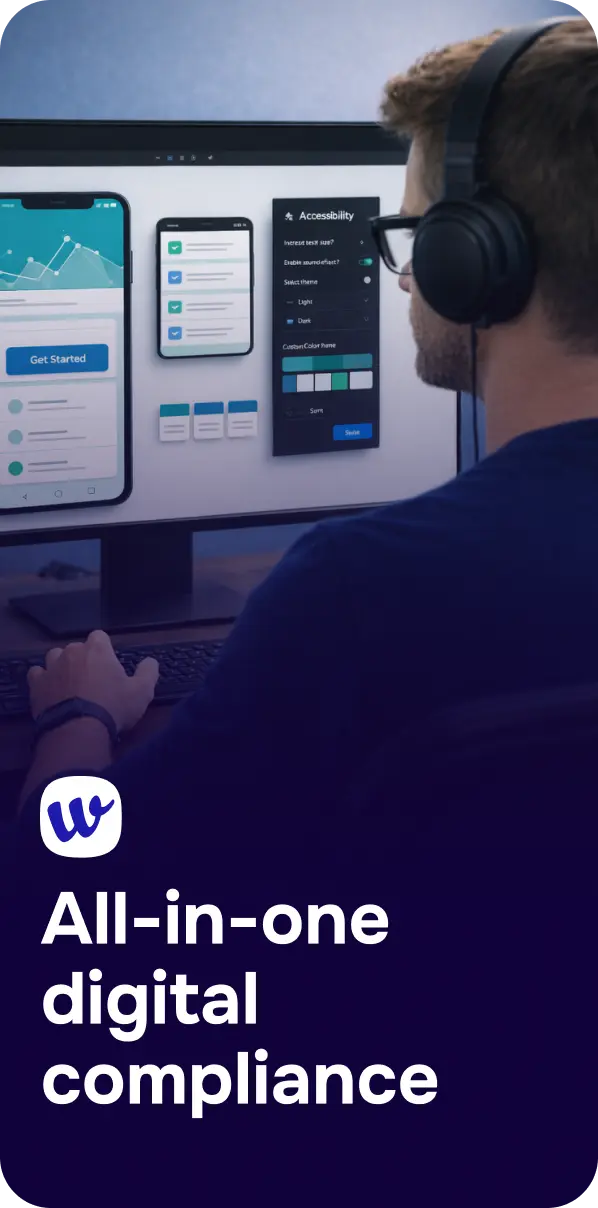
Accessibility isn’t just a “nice to have.” It’s how people with disabilities perceive, understand, navigate, and interact with your website—and it’s also closely tied to WCAG conformance and legal expectations in many regions. If you’re wondering whether your site is accessible, the good news is you can find out with a structured set of checks that combine automation, manual testing, and real-world user perspectives.
This guide walks you through practical ways to evaluate your website against WCAG (Web Content Accessibility Guidelines), interpret what you find, and prioritize fixes that make the biggest difference.
Website accessibility is often measured against WCAG 2.1 or WCAG 2.2, typically at Level AA. WCAG is built around four principles (POUR): content must be Perceivable, Operable, Understandable, and Robust.
In practical terms, you’re checking whether:
Automated testing is the quickest way to surface common issues across pages and templates. It can detect many code-level and pattern-based failures (missing labels, low contrast, empty buttons, ARIA errors), but it cannot fully judge context (whether alt text is meaningful, whether instructions are confusing, whether the reading order makes sense).
Tools you can use include browser-based checkers (like Lighthouse), enterprise scanners, and platform-based audits. For ongoing site changes, a monitoring approach is often more effective than one-off scans—especially if you publish new content frequently.
If you want a single place to run audits and keep track of improvements over time, Corpowid (corpowid.ai) can help teams automate accessibility audits, monitor regressions, and centralize issue reporting so fixes don’t get lost between releases.

Even a short manual review can reveal high-impact accessibility problems that automated tools won’t flag as clearly. Focus on tasks that matter: searching, navigating menus, filling out forms, checking out, contacting support, or submitting an application.
Put your mouse aside. Use Tab, Shift+Tab, Enter, and arrow keys to move through the page.

You don’t have to be an expert to learn a lot from a quick screen reader pass.
Listen for red flags:
Increase browser zoom to 200% and then 400%. Check whether content reflows without requiring horizontal scrolling (especially on mobile-sized viewports) and whether key actions remain usable.
If you need to prioritize, these issues show up constantly across industries and tend to block real users.

Accessibility intersects with legal compliance in many jurisdictions. In the U.S., ADA-related website accessibility litigation has pushed many organizations toward WCAG AA as a practical benchmark. In the EU, the European Accessibility Act (EAA) increases the urgency for many digital products and services.
If you’re exploring what an audit can realistically provide, these guides can help set expectations: Free ADA Audit: What You Really Get and How to Use It to Improve WCAG Compliance and Free EAA Audit: How to Check Website Accessibility for the European Accessibility Act.
It’s also helpful to learn from enforcement trends and settlements. For instance, Fashion Nova’s $5.15 Million Web Accessibility Settlement: What It Means for WCAG Compliance shows how costly accessibility gaps can become. And if you assume public entities are automatically “covered,” Louisiana Website Accessibility Case: Government Sites Are Not Exempt is a reminder that government websites face scrutiny too.
After testing, you’ll likely have a long list. Prioritize by user impact and frequency:
Organizations with limited resources—especially mission-driven teams—often benefit from starting with the pages that serve the most people. If that’s your environment, Digital Accessibility for NGOs & Non-Profit Organizations offers practical context for building an accessibility program without derailing day-to-day operations.
Websites change constantly: new campaigns, new content, new design systems, new third-party widgets. That’s why “we passed an audit once” doesn’t reliably translate to “we’re accessible today.”
Build a sustainable loop:
Platforms like Corpowid (corpowid.ai) support this long-term approach by combining automated audits, monitoring, and tooling that helps teams track accessibility issues as the site evolves—so improvements stick instead of resetting with each update.
If your site fails any of these, that doesn’t mean you’re “bad at accessibility”—it means you’ve identified where to improve. The most important step is to measure consistently, fix what blocks users, and keep accessibility embedded in design and development going forward.
Small accessibility issues on product and checkout pages can create major friction for shoppers and compliance risk for businesses. Here are the e-commerce accessibility UX fixes that deserve attention first.
Choosing between an accessible HTML report and a tagged PDF affects usability, accessibility, maintenance, and compliance readiness. Here’s how to decide which format to publish and when a dual-format approach may be the better option.
Corpowid has been recognized by Gartner, a leading global research and advisory firm, for our innovation and performance in digital accessibility. These badges reflect our commitment to creating inclusive, AI-powered web experiences.






 TR
TR