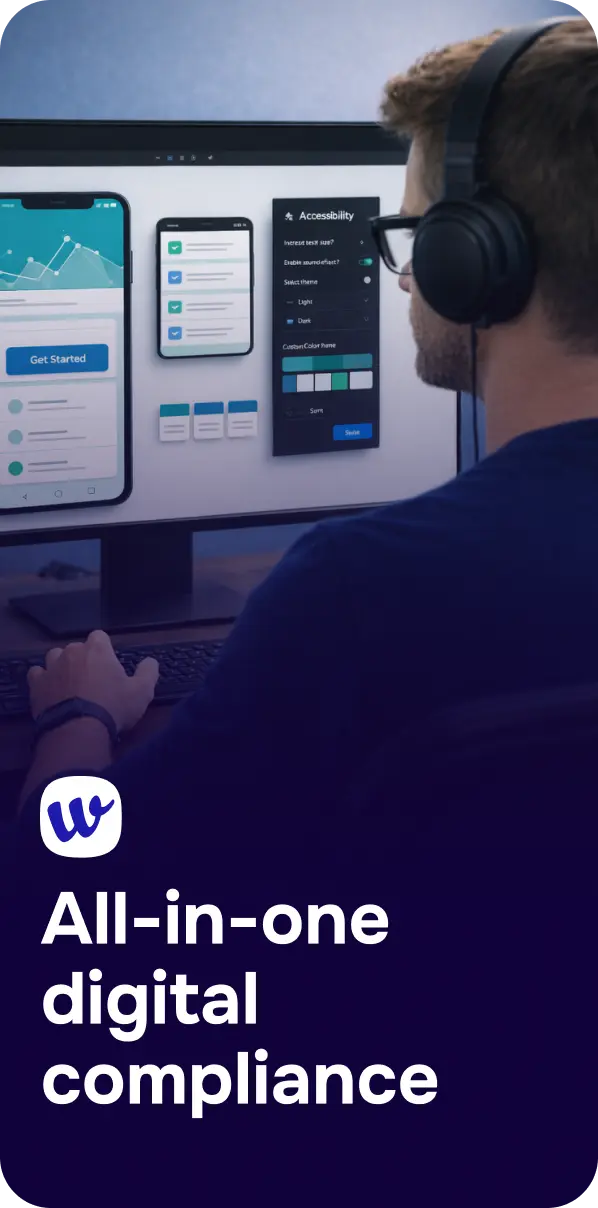
For NGOs and non-profit organizations, your website is often the front door to services, donations, volunteer sign-ups, and crisis information. If that door isn’t accessible—because of unreadable contrast, missing captions, or forms that can’t be completed with a keyboard—you may unintentionally exclude people with disabilities and older users, as well as anyone using assistive technology or browsing in low-bandwidth contexts.
Digital accessibility is both mission-aligned and operationally smart: it increases reach, improves user experience, strengthens credibility with funders, and reduces compliance risk. This article breaks down what accessibility means for nonprofits, how WCAG applies, and practical steps to improve accessibility without derailing your program budget.
Nonprofits serve diverse communities. That includes people who are blind or have low vision, deaf or hard of hearing, have mobility or cognitive disabilities, or use alternative input methods. Accessibility supports:
Accessibility is also increasingly intertwined with legal and reputational risk. Even organizations doing public-good work can face complaints when core services aren’t accessible. Real-world examples show that accessibility expectations apply broadly: see how government sites are not exempt, which is a useful reminder that “we’re serving the public” does not reduce accessibility obligations.
The Web Content Accessibility Guidelines (WCAG) are the most widely used accessibility standard globally. WCAG is organized around four principles—content must be Perceivable, Operable, Understandable, and Robust (POUR). Most organizations aim for WCAG 2.1 AA (and increasingly 2.2 AA), which balances impact and feasibility.
Even if your nonprofit isn’t explicitly named in a specific law, WCAG is the practical benchmark that auditors, procurement teams, and advocates use to evaluate whether a site is accessible.

Nonprofits often ask: “Are we really at risk?” The more accurate question is: “Are people being blocked from our services?” Accessibility is a civil-rights issue, and enforcement trends show that organizations of all types can be challenged when digital barriers prevent equal participation. While high-profile cases often involve retail, the lessons transfer directly—especially for donation flows and account access. The Fashion Nova settlement is a clear example of how costly inaccessibility can become when core online journeys are not usable.
If you operate internationally or serve EU audiences (e.g., accepting donations, running programs, or recruiting volunteers in Europe), you should also track evolving regulations. If you’re starting your evaluation process, a structured check like how to check accessibility for the European Accessibility Act can help you understand what to test and how to document findings.
Accessibility doesn’t have to be an expensive overhaul. Many improvements are process-based and can be integrated into your existing content and web update routines.
Prioritize pages that matter most to your mission and revenue. Typical “top tier” pages include:
Forms are where many nonprofits lose users. Practical fixes include:
Accessibility widgets/overlays can help some users with preference controls (like text size), but they do not replace fixing underlying code and content. Treat any overlay as supplemental. A stronger approach combines remediation, monitoring, and an accurate accessibility statement.
Accessibility isn’t a one-time project. Websites change weekly—new campaigns, new landing pages, new event pages. Build a lightweight governance cycle:
If you’re comparing audit options, it helps to understand what’s included and what isn’t. The guide Free ADA Audit: what you really get explains how to interpret automated results and where you still need human review.
Tools can make this sustainable for small teams. Corpowid (corpowid.ai) can help nonprofits run automated accessibility audits, monitor changes over time, and generate an accessibility statement workflow, so issues don’t reappear unnoticed after a campaign update.
An accessibility statement is more than a legal checkbox—it’s a public commitment and a support channel. A good statement includes:
Some nonprofits also need procurement-ready documentation when partnering with public agencies, universities, or large donors. If you’re asked for a VPAT (Voluntary Product Accessibility Template) or similar evidence, budgeting and scope can be confusing—VPAT cost provides a realistic breakdown of what documentation work involves.
Corpowid (corpowid.ai) can support this transparency by helping you keep audits, issue tracking, and statement updates aligned—useful when stakeholders ask what you tested, what you fixed, and what’s next.
When nonprofit websites are accessible, more people can donate, volunteer, and benefit from your services independently. WCAG-aligned improvements also tend to make sites faster, clearer, and easier to use for everyone. Start with the journeys that matter most, fix recurring template issues, and build a lightweight process so accessibility improves with every update—not just during a redesign.
Small accessibility issues on product and checkout pages can create major friction for shoppers and compliance risk for businesses. Here are the e-commerce accessibility UX fixes that deserve attention first.
Choosing between an accessible HTML report and a tagged PDF affects usability, accessibility, maintenance, and compliance readiness. Here’s how to decide which format to publish and when a dual-format approach may be the better option.
Corpowid has been recognized by Gartner, a leading global research and advisory firm, for our innovation and performance in digital accessibility. These badges reflect our commitment to creating inclusive, AI-powered web experiences.


 TR
TR