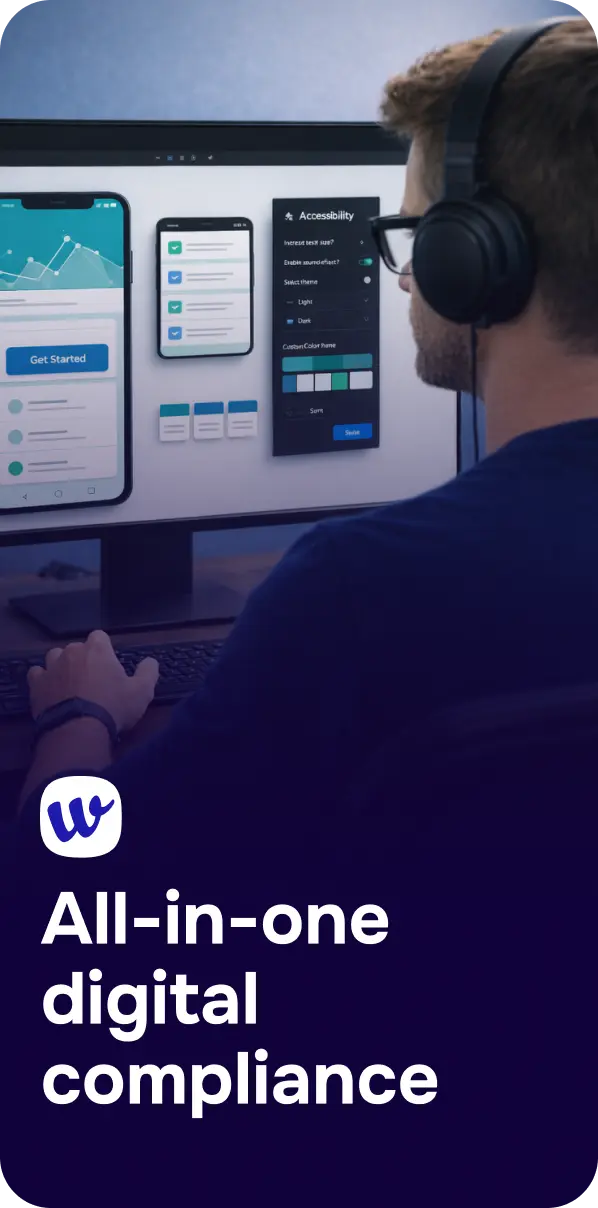
Ensure every PDF you publish is fully accessible, legally compliant, and optimized for assistive technologies — meeting WCAG 2.1 / 2.2 AA, PDF/UA, Section 508, ADA, EN 301 549, and EAA standards.
Get a free PDF accessibility audit
PDF accessibility ensures that documents are readable, navigable, and understandable for people with disabilities. This includes users who rely on screen readers, keyboard navigation, or assistive technologies. Without accessibility, users with visual, cognitive, or motor disabilities cannot interact with your documents — causing legal, usability, and reputational risks.
 Proper tagging & structure
Logical reading order
Accessible tables and forms
Navigation via bookmarks
Images with proper alt text
Correct metadata and language settings
Proper tagging & structure
Logical reading order
Accessible tables and forms
Navigation via bookmarks
Images with proper alt text
Correct metadata and language settings
Avoid ADA lawsuits, EU enforcement, and Section 508 penalties. Accessible PDFs are mandatory for government, enterprise, education, and public websites.
Accessible documents ensure everyone can interact with your content — including people with visual, cognitive, and motor disabilities.
PDF accessibility improves the customer experience and strengthens brand trust, helping you reach a wider audience while reducing legal risk and remediation costs.
Corpowid ensures your PDFs meet or exceed global accessibility standards. Every document is manually remediated by accessibility experts.
To ensure your digital content is inclusive for everyone, your PDFs will fully comply with major regulatory frameworks such as
| Free $0 /month | Growth $39 /month | Enterprise $99 /month | Custom Contact us | |
|---|---|---|---|---|
| End-user accessibility widget |  |
|
|
|
| Page-based scan & live score | |
|
|
|
| Continuous full-site monitoring |  |
|
|
|
| Alt text manager | |
|
|
|
| Cookie manager | |
|
|
|
| Technical SEO audit | |
|
|
|
| Chrome accessibility toolkit | |
|
|
|
| Figma accessibility plugin | |
|
|
|
| Team Management | |
|
|
|
| Usage Analytics | |
|
|
|
| Mobile app accessibility IOS/Android | |
|
|
|
| AI Fixer | |
|
|
|
| AI Alt Text Generator | |
|
|
|
| Schema Markup Manager | |
|
|
|
| Meta Tag Manager | |
|
|
|
| Document Accessibility Remediation | |
|
|
|
| AI Video Subtitle and Caption Manager | |
|
|
|
| Tailored accessibility strategy | |
|
|
|
| Dedicated expert consultation | |
|
|
|
| Email support | |
|
|
|
| Domain | Single Domain | Single Domain | Single Domain | Unlimited domains · SLA |
| Tier | Up to 300K Page Views | Up to 500k Page Views | Up to 1M Page Views | Unlimited |
| Get Started | Get Started | Get Started | Contact Us |
Find helpful information to answer your questions
PDF and document accessibility means ensuring that all digital documents — PDFs, Word files, PowerPoints, and more — can be easily read and navigated by people with disabilities, including those using assistive technologies like screen readers, keyboard navigation, and text-to-speech tools. It is a core part of full compliance that overlays alone cannot deliver, which is why Corpowid provides expert document remediation as part of our 360-degree service.
Accessible documents help organizations comply with global standards (WCAG 2.1/2.2, ADA, Section 508, EN 301 549) and ensure inclusive access for all users. They also improve user experience and search engine visibility while reducing the legal risk associated with accessibility lawsuits.
We provide expert remediation for PDFs, Microsoft Office files (Word, Excel, PowerPoint), scanned documents, forms, interactive PDFs, reports, manuals, catalogs, and brochures.
Our remediation transforms complex documents into fully accessible assets. We handle everything from fundamental tagging structures — headings, lists, and tables — to detailed alternative text for images and charts. We carefully calibrate reading order, document language settings, and color contrast so every user has an equitable experience. By optimizing metadata and form-field accessibility, we ensure conformance with WCAG, ADA, and Section 508 through a rigorous process that blends AI efficiency with expert human oversight.
We follow accepted global standards: WCAG 2.1 & 2.2 AA, PDF/UA, ADA Title III, and Section 508. Our team uses a combination of automated tools, AI enhancements, and manual expert review to ensure conformance.
Turnaround depends on document complexity and page count. Typical ranges are 24–72 hours for standard documents, 3–10 days for large reports or manuals, and a custom timeline for bulk remediation. Rush delivery is available.
Yes. Every remediated document includes an accessibility compliance report, a list of issues fixed, validation tests (including screen reader testing when required), and PDF/UA verification on request.
Yes. We convert scanned or image-only PDFs using advanced OCR, then manually rebuild structure, tagging, and accessibility layers.
Pricing is based on document length, technical complexity (tables, charts, forms, etc.), original file quality (digital vs. scanned), and timeline. We offer transparent per-page rates and volume discounts for larger projects.
Yes. We offer monthly or quarterly remediation plans and comprehensive accessibility audits for websites and document repositories. Our services also include internal team training and enterprise support to maintain continuous, accessible document workflows.
You can request a free accessibility evaluation by sending us your documents. We'll provide a quick audit, pricing, and an estimated delivery timeline.
Corpowid has been recognized by Gartner, a leading global research and advisory firm, for our innovation and performance in digital accessibility. These badges reflect our commitment to creating inclusive, AI-powered web experiences.


 TR
TR