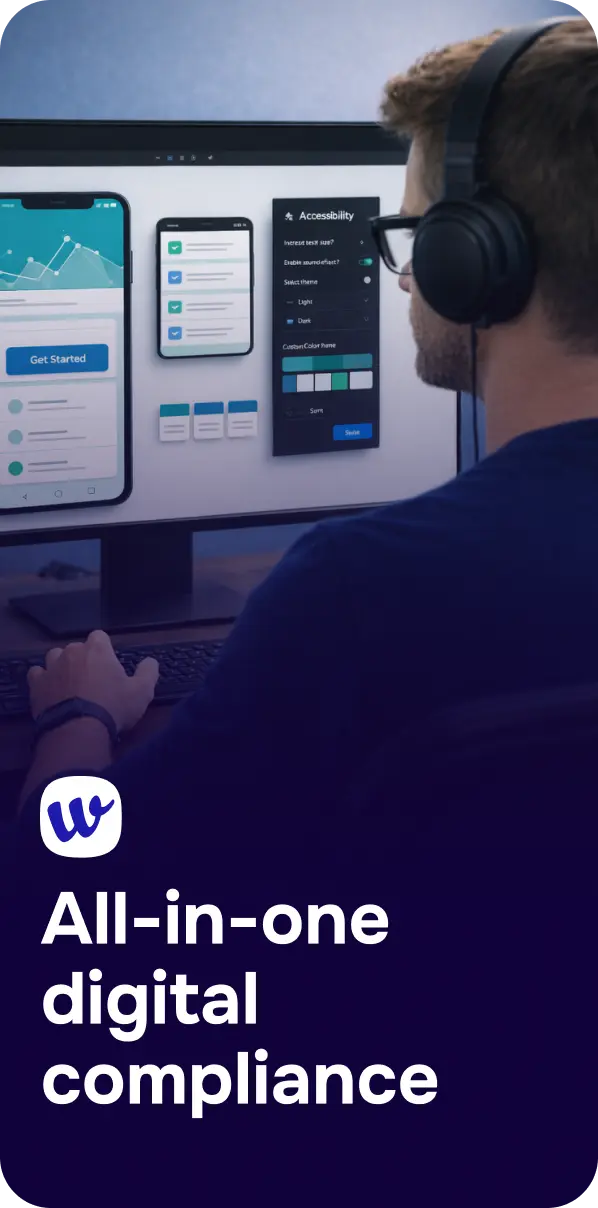
When a Louisiana website accessibility case makes headlines, it’s rarely because the underlying issues are new. It’s because the consequences finally catch up. Public-sector websites and digital services are essential infrastructure—used to apply for benefits, pay taxes, register to vote, access court information, and request records. If those experiences aren’t usable by people with disabilities, the impact is immediate and measurable.
The key lesson is simple: government sites are not exempt from accessibility obligations. In fact, they’re often held to higher expectations because they deliver critical services and are funded by the public.
Website accessibility is fundamentally about equal access. If a resident can’t complete a form with a screen reader, can’t interpret a PDF, or can’t use a map widget without a mouse, they may be effectively blocked from public services. That creates real harms—missed deadlines, lost benefits, and reduced civic participation.
In the U.S., digital access intersects with disability rights law and procurement standards. A Louisiana case (or any similar action) typically follows a familiar pattern:
The reputational damage can be as costly as the legal exposure—especially when the site is a public-facing service portal.

State and local governments fall under Title II of the Americans with Disabilities Act (ADA). Title II requires that programs, services, and activities be accessible to people with disabilities. Increasingly, agencies and courts interpret government websites and mobile apps as part of those services—meaning accessibility barriers can be treated as discrimination.
Even when regulations vary over time, the direction is consistent: digital services must be usable by people with disabilities, not only “available” in theory.
Many government entities also align with Section 508 principles (especially in federal contexts and in vendor contracts). Section 508 references accessibility requirements for information and communication technology and typically points to WCAG-based success criteria.
This is especially relevant in Louisiana and elsewhere because vendors often build, host, or maintain government sites. If the platform is inaccessible, liability and remediation costs can cascade across procurement relationships.
Most accessibility settlements, remediation plans, and public-sector policies point to WCAG (Web Content Accessibility Guidelines), usually WCAG 2.1 AA (and increasingly WCAG 2.2 AA). WCAG isn’t a law, but it is the most widely used technical benchmark to define what “accessible” means on the web.
Government websites tend to share a set of high-risk patterns because of forms, PDFs, third-party tools, and legacy templates. The issues below are frequently involved in complaints and remediation demands:
These aren’t edge cases. They can block core tasks like paying a utility bill, renewing a license, or submitting a public records request.

A common misconception is that public agencies get flexibility because of limited budgets, older systems, or procurement constraints. While agencies may face practical challenges, accessibility obligations generally don’t disappear because a website is complicated or the CMS is outdated.
In practice, government organizations are expected to:
It’s also worth noting that legal pressure is not limited to government. Private-sector enforcement trends show how quickly costs can rise when accessibility is ignored; for context, see Fashion Nova’s $5.15 million web accessibility settlement and how it reframed expectations around WCAG compliance and ongoing monitoring.
Start with an inventory of:
Accessibility risk often hides in “small” parts of a site—like one frequently used PDF or a critical checkout widget.
Automated tests can catch many issues (contrast failures, missing labels, broken headings), but government portals also need manual validation—keyboard-only navigation, screen reader checks, and form workflows. If you’re exploring what an audit should include and how to interpret results, the guide Free ADA Audit: What You Really Get and How to Use It breaks down what’s meaningful versus what’s just a superficial scan.
Platforms like Corpowid (corpowid.ai) can help agencies and contractors run automated accessibility audits and monitoring across templates and content changes, which is especially useful for sprawling government sites with frequent updates.
Prioritize fixes that block essential tasks:
This approach reduces real-world harm quickly and builds momentum for broader remediation.
An accessibility statement sets expectations, documents standards (e.g., WCAG 2.1 AA), and provides an accessible channel for feedback. It also creates accountability for ongoing improvements—important when content and vendors change over time.
Many government sites fail accessibility not because teams don’t care, but because requirements weren’t baked into contracts and content workflows. Set clear expectations for vendors and internal teams, including:
For teams that need formal documentation, budgeting, or procurement justification, VPAT Cost: What It Really Takes to Document Accessibility Compliance offers a useful lens into what’s involved and why it matters.

Accessibility isn’t only about avoiding complaints. Inclusive design improves usability for everyone—clearer forms, better error handling, readable typography, and mobile-friendly interactions. These changes reduce support calls, increase completion rates, and make services more resilient during emergencies or high-demand periods.
Even if your organization is focused on U.S. requirements today, it’s also helpful to understand how accessibility expectations are evolving globally. If you work with international audiences or vendors, Free EAA Audit: How to Check Website Accessibility for the European Accessibility Act provides a practical overview of how accessibility readiness is assessed under the EAA.
If you manage a Louisiana government site—or you’re a vendor supporting one—take these immediate steps:
Corpowid (corpowid.ai) can support this cycle with automated audits, continuous monitoring, and tooling to help maintain an accessibility statement—useful for agencies trying to operationalize accessibility across multiple departments and frequent site changes.
A Louisiana website accessibility case is a reminder that digital services are public services. Agencies that treat WCAG alignment as a “later” project risk excluding constituents and escalating legal exposure. The most sustainable path is to build accessibility into day-to-day operations: audit, remediate, monitor, and govern—so every resident can access essential services with dignity and independence.
And when accessibility becomes part of how a government site is designed and maintained—not a one-time retrofit—compliance becomes easier, user experience improves, and public trust strengthens.
Small accessibility issues on product and checkout pages can create major friction for shoppers and compliance risk for businesses. Here are the e-commerce accessibility UX fixes that deserve attention first.
Choosing between an accessible HTML report and a tagged PDF affects usability, accessibility, maintenance, and compliance readiness. Here’s how to decide which format to publish and when a dual-format approach may be the better option.
Corpowid has been recognized by Gartner, a leading global research and advisory firm, for our innovation and performance in digital accessibility. These badges reflect our commitment to creating inclusive, AI-powered web experiences.







 TR
TR