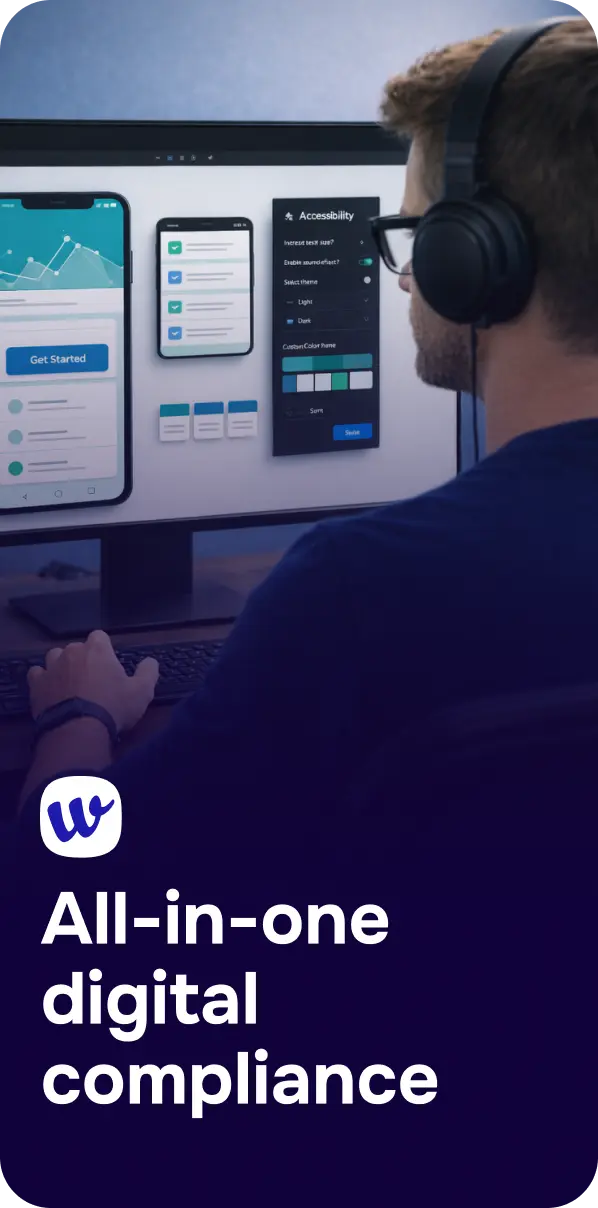
“Free widget” sounds like the easiest way to make a website accessible—and in one sense, it can be. Accessibility widgets (often called overlays or toolbars) typically add an on-screen panel that lets visitors change contrast, increase text size, pause animations, highlight links, or adjust spacing. For some users, those controls can reduce friction and make content easier to read right away.
But here’s the key truth: a widget can improve user preference controls; it cannot automatically fix all the underlying accessibility issues that keep a website from meeting WCAG. If you want your website to genuinely welcome everyone—including people who use screen readers, keyboard-only navigation, voice control, or switch devices—you need to pair any widget with real, testable accessibility work in your code and content.
Most widgets offer a set of front-end adjustments that can help certain visitors, especially people with low vision, reading difficulties, or light sensitivity. Common features include:
These can be valuable comfort features, but they don’t replace accessibility fundamentals like semantic HTML, correct labels, error identification, accessible navigation, and meaningful alternative text.

WCAG (Web Content Accessibility Guidelines) is largely about whether your site is perceivable, operable, understandable, and robust. Many requirements can’t be “overlaid” at runtime because they depend on structure, code semantics, and content quality.
If a modal, menu, or carousel can’t be used with a keyboard—or if focus jumps unpredictably—an overlay won’t reliably correct that. WCAG expects that all functionality is available from a keyboard (and that focus is visible and logical). Widgets may add a focus highlight, but they cannot rewrite complex interactive logic safely across every component.
Screen readers rely on proper headings, landmarks, form labels, button names, and ARIA used correctly. If your “button” is actually a styled <div> with no accessible name, a widget doesn’t magically turn it into a real button with meaningful semantics.
Alt text is content, not a styling preference. A widget cannot know what your images mean in context. If your site relies on images for instructions, charts, or product details, you need accurate alt text and/or text equivalents. If you’re working on image accessibility at scale, see AI alt text generator and benefits for practical guidance.
WCAG covers clear error identification, instructions, and helpful suggestions. A widget doesn’t rewrite validation messages, connect them to inputs, or ensure errors are announced to screen readers. Those are implementation details you must build into your forms.
You can—if you treat it as an assistive layer, not a compliance shortcut. Think of it like adding curb cuts to a sidewalk: helpful, but you still need ramps, signage, and safe crossings.
A responsible approach looks like this:
This approach is also good for SEO and usability. Accessibility improvements tend to strengthen site structure and clarity, which supports search performance. For a deeper look at how the two connect, read Technical SEO and Accessibility: How to Build Websites That Rank and Work for Everyone.

If you’re adding a free widget, pair it with the following practical steps to move toward WCAG compliance (commonly WCAG 2.1 AA or WCAG 2.2 AA, depending on your policy and region).
Run automated tests to catch common issues (missing alt attributes, low contrast patterns, form label gaps, heading structure problems, ARIA misuse, and more). Automation won’t catch everything, but it’s an efficient baseline and helps you prioritize.
Platforms like Corpowid (corpowid.ai) can automate audits and ongoing monitoring so you can see what’s broken, where it lives, and whether fixes actually reduce risk over time.
Manually test key user journeys: navigation menus, search, checkout, account registration, contact forms, and support flows. Ask:
Accessibility issues usually live in reusable components: header menus, accordions, sliders, tabs, popups, and form fields. Fixing the component fixes every page that uses it—saving time and creating consistency.
AI can speed up certain tasks—like suggesting alt text, summarizing issues, or mapping patterns across templates—but you still need human review and clear acceptance criteria. If you’re exploring practical AI workflows for accessibility teams, see Artificial Intelligence and Accessibility: Practical Ways to Meet WCAG and AI for Good Summit: Turning Responsible AI into Real Web Accessibility.
An accessibility statement sets expectations, documents your target standard (for example, WCAG 2.2 AA), lists known limitations, and gives users a way to request help or report barriers. It also helps organizations show ongoing effort—important for trust, governance, and procurement.
If you operate in regulated environments or serve public sector audiences, keep an eye on policy signals and equality objectives that affect digital services. For context, read DSIT’s Equality Objectives: What They Mean for Digital Accessibility and WCAG Compliance.

A truly welcoming website is one where:
A widget can support some of these needs—but accessibility is ultimately a product quality practice, not a single plugin.
If you decide to add a free accessibility widget, treat it as a visitor-friendly set of preferences and pair it with measurable improvements to your site’s code, content, and design system. You’ll reduce barriers, improve usability for everyone, and move closer to WCAG conformance in a way you can validate.
For teams that need a repeatable process—audits, continuous monitoring, and tooling to support accessibility documentation—Corpowid (corpowid.ai) can help you track issues over time and build a more reliable compliance workflow while you keep improving the real experience behind the widget.
AI agents are starting to browse, evaluate, and act on websites like human users. This article explains why checkout accessibility matters for AI agents, where common barriers appear, and how digital teams can prepare more resilient, compliant user journeys.
Corpowid has been recognized by Gartner, a leading global research and advisory firm, for our innovation and performance in digital accessibility. These badges reflect our commitment to creating inclusive, AI-powered web experiences.






 TR
TR