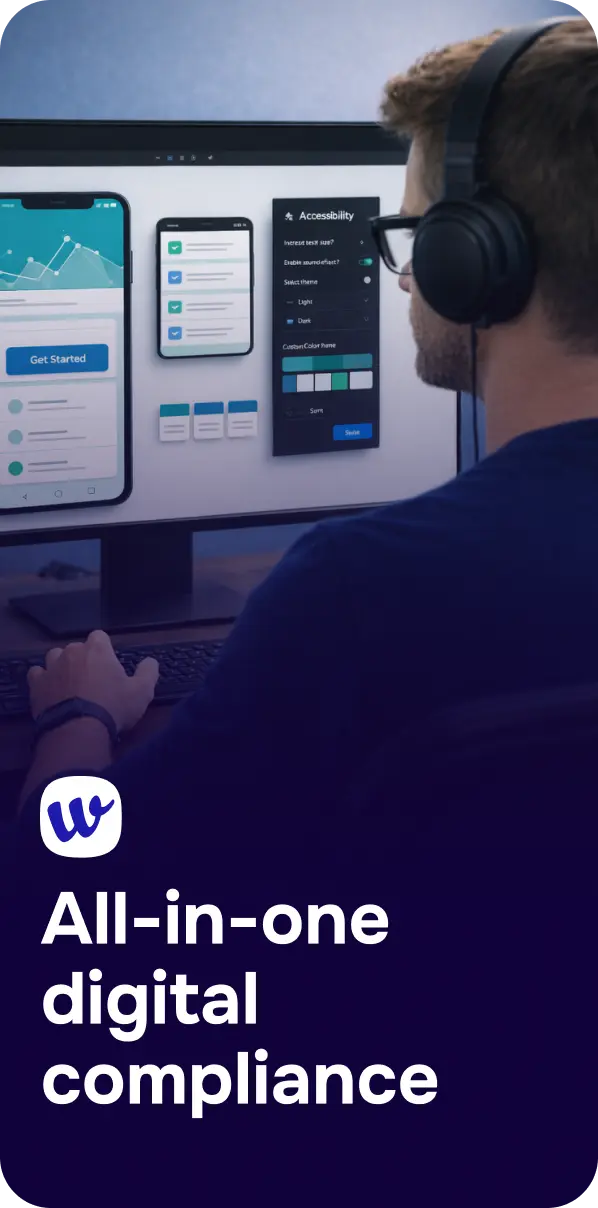
The European Accessibility Act (EAA) is no longer a “someday” compliance project. With enforcement now active, 2026 is when many organizations are feeling the real operational impact: audits are being requested, accessibility statements are being scrutinized, and procurement teams are asking vendors for measurable proof of conformance.
This article breaks down what changed in 2026, what the EAA expects for digital products, and how to build a practical, WCAG-aligned compliance workflow that holds up under enforcement.
The EAA is an EU directive designed to improve accessibility across key products and services in the internal market. In practice, it pushes organizations to remove barriers for people with disabilities—especially in digital experiences—so that buying, banking, reading, booking, and communicating online works for everyone.
For digital teams, the EAA commonly translates into alignment with recognized accessibility standards (most notably WCAG) and a need to demonstrate ongoing accessibility rather than one-time fixes.
Many teams treated 2025 as the “big date” because that’s when the EAA’s requirements became applicable across the EU. What changed in 2026 is that accessibility is now being treated as an enforceable consumer-rights and market-access issue, not a best-effort initiative.
In 2026, it’s less about whether you intend to be accessible and more about whether you can demonstrate it. That usually means:
Accessibility statements are no longer “nice to have.” Under enforcement, they function as a public-facing compliance document that can be evaluated against actual user experience. If your statement claims conformance but key flows (like checkout or account login) fail keyboard navigation or screen reader use, that mismatch can create risk.
A major 2026 shift is commercial: enterprise buyers and public-sector customers increasingly require accessibility documentation during vendor selection and renewal. Expect to see requests for WCAG conformance claims, audit summaries, and remediation roadmaps as standard.
Enforcement-era accessibility is about durability. Sites change weekly; design systems evolve; content teams publish daily. In 2026, “we ran an audit last year” is not a strong defense if updates introduced new barriers. Monitoring, regression prevention, and repeat testing are now table stakes.
The EAA covers a range of consumer-facing products and services. For many organizations, the most relevant areas are digital touchpoints tied to essential services and commerce, such as:
If you operate in multiple EU markets, note that enforcement is carried out at the member-state level, but the expectation is consistent: barriers that prevent access for people with disabilities need to be identified, fixed, and prevented from reappearing.

While the EAA is not a WCAG checklist, WCAG is the most common technical standard used to evaluate digital accessibility. If you want a practical grounding in how WCAG maps to regulations and real-world compliance workflows, see Digital Accessibility and Regulations: A Practical Guide to WCAG Compliance.
In enforcement conversations, the issues that surface most often are the ones that break core user journeys:
If you’re reacting to enforcement pressure, the goal is to move from scattered fixes to an accountable system. Here’s a sequence that works for most teams.
Start with the flows that expose you to the most risk and user impact: account creation, login, checkout, payment, booking, customer support, and any legally or financially significant steps. Prioritize these for manual testing (keyboard + screen reader) alongside automated scans.
Automated testing alone won’t catch everything, but it’s the fastest way to create consistent coverage across templates and releases. A platform like Corpowid (corpowid.ai) can help teams run automated accessibility audits and ongoing monitoring so regressions don’t slip into production unnoticed.
If you need a quick way to spot issues on specific pages during triage, tools like browser-based testing can help; for example, Test Any Page on the Fly With the Corpowid Chrome Extension explains a lightweight workflow for rapid checks during QA and content updates.
Enforcement pressure often reveals a deeper problem: accessibility was treated as a late-stage QA task. In 2026, the most efficient path is shifting checks earlier—during design and component creation—so issues are prevented, not chased. This is especially effective for design systems and shared UI libraries.
For design teams, baking checks into the workflow reduces rework. A good starting point is Shift Accessibility Left: Why Designers Should Run Accessibility Checks Inside Figma, which outlines how to catch problems like insufficient contrast, missing states, and poor focus order before a single line of code ships.
If your process spans design to live testing, From Design to Live Site: How ScanAndFox, Our Figma Plugin, and Chrome Extension Work Together shows how teams can connect early checks with in-browser verification for a smoother compliance pipeline.
An accessibility statement should reflect current status, known limitations, and a plan for improvements—plus a clear contact method for users who need help. The key in 2026 is accuracy: statements that overpromise create credibility and legal risk. Treat it as a living document that changes as your product changes.
Make accessibility sustainable by assigning ownership and setting routines:
Corpowid (corpowid.ai) supports this operational approach by helping teams monitor accessibility over time and centralize findings so fixes can be prioritized and verified across updates.

Overlays/widgets can improve certain user controls, but they typically don’t fix underlying code-level issues like missing labels, broken focus order, or inaccessible custom components. Under enforcement, you’ll be evaluated on the actual usability and technical accessibility of the experience.
Automation is essential for scale, but it doesn’t replace manual testing. Enforcement-driven programs blend both: automated monitoring for breadth and manual testing for depth.
Accessibility improvements often boost usability for everyone: clearer forms reduce abandonment, better contrast helps mobile users outdoors, and keyboard support benefits power users and temporary impairments.
You don’t need perfection to make meaningful progress, but you do need control and transparency. In 2026, a strong posture usually means you can answer these questions confidently:
Enforcement has effectively moved accessibility from a “project” to a product quality system. Teams that treat it like performance, security, and reliability—measured, monitored, and owned—are the ones best positioned to thrive in the post-2026 landscape.
Corpowid has been recognized by Gartner, a leading global research and advisory firm, for our innovation and performance in digital accessibility. These badges reflect our commitment to creating inclusive, AI-powered web experiences.





 TR
TR