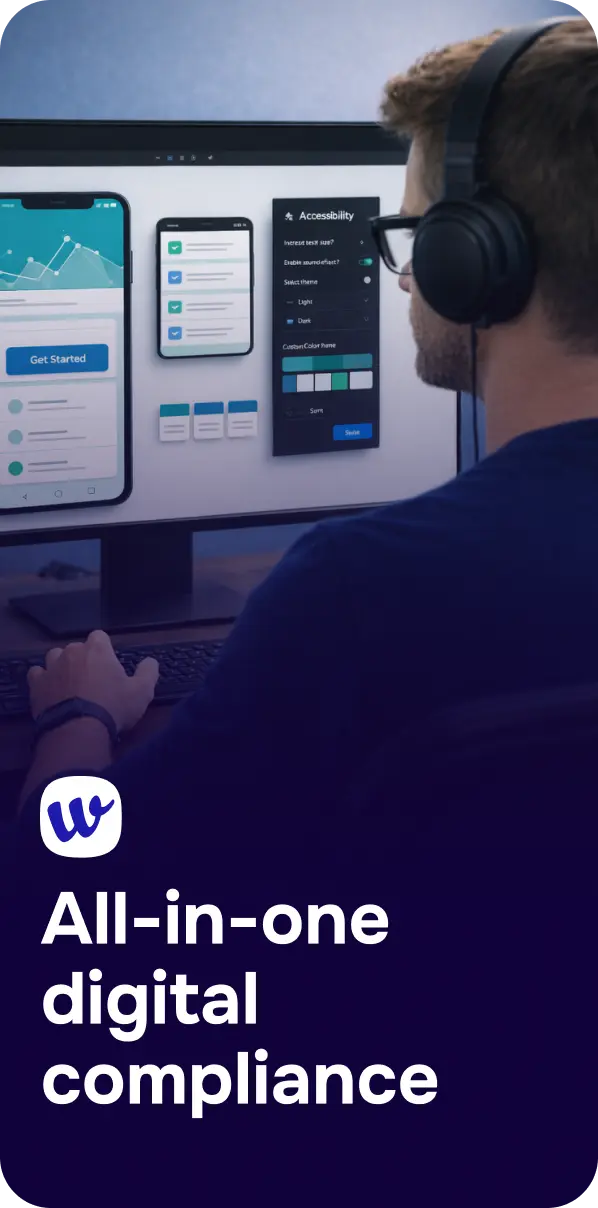
If you are searching for a free accessibility widget WordPress solution, you are likely trying to improve usability quickly across one or more websites without creating a heavy implementation project. The same need often applies to Shopify and Webflow teams as well: move fast, reduce friction for visitors, and support a stronger accessibility posture.
An accessibility widget can be a useful first step, especially for teams that want a visible interface for visitor-facing accessibility controls. But it works best when it is treated as one part of a broader digital compliance process that includes auditing, fixes, monitoring, and ongoing updates as standards and site content change.
This guide explains how to approach setup on WordPress, Shopify, and Webflow, what to verify before publishing, and where a widget fits into a larger accessibility and compliance workflow.

An accessibility widget is typically a script-based interface added to a website that gives visitors access to usability options from the front end. Depending on the implementation, it may help users adjust how they experience the site and give your team a faster way to deploy a visible accessibility layer.
For digital teams, the main appeal is simplicity: one script, one interface, and a faster launch path than rebuilding site components from scratch. For organizations managing multiple compliance obligations, a widget may also sit alongside privacy, cookie consent, and legal transparency features in a more unified platform approach.
If you want to understand how a broader, consolidated website layer can work, see Inside the 4-in-1 Widget: Accessibility, Consent, Legal and Company Info in One Script.
A free accessibility widget can be a practical option when your team needs to:
This is especially relevant for lean digital teams, marketing teams managing multiple web properties, and organizations that need a faster path to operational improvements while broader remediation work is planned.
A widget can help create a more accessible user experience layer and provide a straightforward deployment path across common platforms. It can also support internal momentum by making accessibility more visible as an active workstream rather than a one-time project.
A widget should not be treated as the entire accessibility strategy. Website accessibility compliance depends on the underlying site experience, content structure, templates, and ongoing monitoring. In practice, teams should think in terms of audit, fix, monitor, and update rather than install once and move on.
Before adding any accessibility widget to WordPress, Shopify, or Webflow, align on a few basics:
This last point matters. Many organizations are not dealing only with accessibility. They also need cookie consent, privacy transparency, and legal compliance controls that work together instead of creating fragmented scripts and disconnected ownership.

WordPress is often the easiest place to start because teams usually have access to theme files, plugins, or tag management tools. The exact method depends on how the widget provider delivers the code, but the process usually follows the same pattern.
If your team manages theme files directly, the widget script is commonly inserted into the global header or footer area so it loads sitewide. This is often the cleanest route when you want consistent deployment across all pages.
Before publishing, verify that:
For non-technical teams, a header and footer code management plugin may be the simplest approach. It allows you to place the script without editing theme files directly.
This can be useful if marketing or compliance teams need a lower-friction deployment process, but it is still important to test across page types, especially if your site uses custom templates or page builders.
If your organization uses a tag manager, you may prefer to deploy the widget there for easier control and versioning. This can help when multiple teams need visibility into what is running on the site.
However, tag-managed deployments should still be checked carefully to confirm timing, load behavior, and interactions with consent settings or other scripts.
Shopify teams usually want a setup path that is fast, stable, and easy to maintain without disrupting storefront performance. In most cases, implementation happens through theme code, app settings, or custom script placement depending on the tool you choose.
A common approach is to place the script in the main theme layout so it appears across the storefront. This helps keep the experience consistent across product pages, collection pages, and checkout-adjacent journeys where applicable.
After installation, review:
Shopify stores often include apps, custom themes, promotional overlays, and conversion tools. These can affect how a widget appears or behaves. Make sure the launcher remains easy to access and does not interfere with key storefront actions.
If your store also relies on consent management, coordinate the accessibility widget with your privacy setup so the overall visitor experience stays clear and consistent. For related privacy work, see How to Run a Cookie Audit on Your Website in 5 Steps.
Webflow gives teams strong design control, which makes it a popular choice for marketing sites and modern web experiences. Widget setup is usually straightforward, but design-heavy sites should pay close attention to placement and visual conflicts.
In many Webflow setups, the widget script is inserted through project-level custom code so it loads across the full site. This is typically the easiest way to maintain consistency without editing page by page.
Once added, publish to staging or preview and test key templates before pushing live.
Because Webflow sites often use fixed elements, animations, and layered interactions, the widget launcher should be reviewed against:
The goal is not only to make the widget available, but to make it discoverable and usable in a way that fits the rest of the interface.
Installing the widget is only the beginning. To get real value from it, teams should follow a simple post-launch process.
Check the homepage, high-traffic landing pages, forms, product or service pages, and mobile views. Look for conflicts with other floating elements and confirm the widget remains visible and functional.
Make sure the widget does not distract from navigation, checkout flows, lead forms, or primary calls to action. Accessibility improvements should support usability, not create new friction.
Accessibility is ongoing. New content, design changes, third-party scripts, and platform updates can all affect compliance posture over time. A more resilient approach includes continuous monitoring and operational follow-through rather than one-time deployment.
For teams exploring a more automated future state, AI Agents Are Here: How Autonomous AI Will Quietly Take Over Your Accessibility To-Do List offers useful context.

For most organizations, accessibility is connected to a wider set of digital obligations. The challenge is not just adding one tool. It is managing accessibility, privacy, consent, and legal transparency in a way that is operationally sustainable.
That is where a unified platform approach becomes more valuable than a collection of disconnected scripts. According to Corpowid's positioning, the platform brings accessibility, cookie consent, and legal compliance together in one AI-driven environment, with ongoing monitoring and updates as regulations change.
For businesses that need WCAG 2.2, ADA, EAA, and GDPR readiness, this kind of consolidation can reduce fragmentation between compliance, privacy, and digital teams.
If you are comparing a free accessibility widget across WordPress, Shopify, and Webflow, focus on practical questions:
The right answer depends on your internal resources, site complexity, and regulatory exposure. A free widget may be a good starting point, but teams with broader compliance needs often benefit from a platform that unifies accessibility, consent, and legal controls in one place.
A free accessibility widget for WordPress, Shopify, and Webflow can be a smart first step for teams that want faster implementation and a visible accessibility interface on their websites. The key is to treat setup as the beginning of a process, not the end of one.
When you combine a widget with auditing, monitoring, and a unified compliance strategy, you create a stronger foundation for long-term accessibility and digital trust. For organizations looking to simplify that process, Corpowid’s platform approach is designed around bringing accessibility, cookie consent, and legal compliance together under one system.
A widget can be a useful starting point, but it should not be treated as the full accessibility strategy. Teams should also review underlying site structure, content, templates, and ongoing monitoring.
Many script-based solutions are designed to work across different website platforms. The exact setup method may vary, but the main process usually involves adding a sitewide script and testing how it behaves on each platform.
The launcher should be easy to find without blocking navigation, chat tools, consent banners, or calls to action. Always test placement on both desktop and mobile.
Not necessarily. Many organizations benefit from managing accessibility, privacy, cookie consent, and legal transparency together so digital compliance is easier to operate and maintain.
A free accessibility widget may add convenience features, but it is not the same as a full accessibility audit. Here’s what businesses should understand about EAA expectations, risk reduction, and building a stronger compliance process.
Free accessibility widgets can be useful for quick interface adjustments, but they are not all built the same. This honest comparison explains what to look for, where free tools help, where they fall short, and how to choose the right approach for accessibility and compliance in 2026.
Corpowid has been recognized by Gartner, a leading global research and advisory firm, for our innovation and performance in digital accessibility. These badges reflect our commitment to creating inclusive, AI-powered web experiences.







 TR
TR