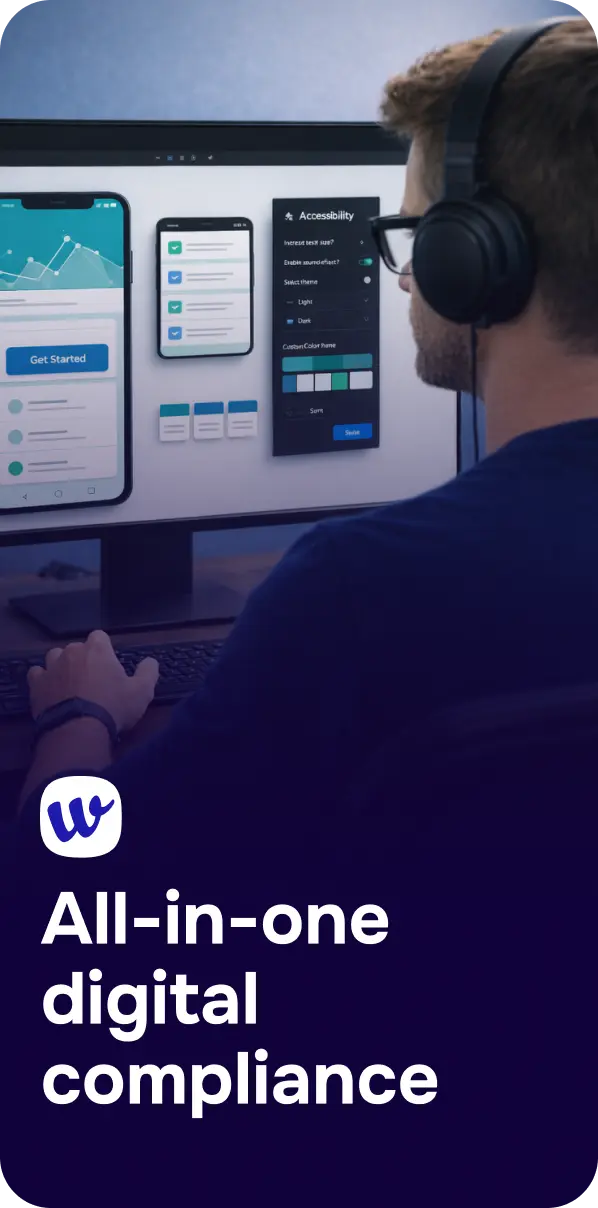
A free accessibility widget can look like an easy win: add one script, place an icon on the site, and offer visitors controls for contrast, text size, or reading support. For busy digital teams, that promise is understandably appealing.
But there is an important difference between adding accessibility options and achieving website accessibility compliance. A widget may improve parts of the user experience for some visitors, yet still leave major accessibility barriers in place across templates, navigation, forms, media, and code.
If you are evaluating a free accessibility widget, the right question is not whether it adds features. It is whether those features address the real accessibility work your site needs. This page breaks down what you actually get, what you do not get, and how to assess whether a widget fits into a broader compliance strategy.

Most free accessibility widgets focus on front-end controls that visitors can activate themselves. These are typically designed to make parts of the interface easier to view or interact with.
Depending on the tool, a free accessibility widget may include options such as:
These controls can be useful for some users, especially when they are implemented clearly and do not interfere with the site experience.
A widget can provide immediate interface adjustments without requiring a full redesign. For organizations early in their accessibility journey, that may feel like a practical starting point. It can also signal that your team is thinking about usability and trying to offer visitors more control.
In some cases, widgets are also attractive because they are easy to deploy across multiple pages with minimal development effort.
This is where many teams run into trouble. A free accessibility widget may change how a page looks or behaves on the surface, but it usually does not fix the underlying issues that create accessibility barriers in the first place.
Accessibility issues often come from the site’s structure, markup, components, and content patterns. A widget generally does not rebuild those foundations. For example, it may not fully resolve problems involving:
These are the kinds of issues that typically require auditing, design review, code changes, content updates, and ongoing monitoring.
A free accessibility widget is not the same thing as meeting accessibility requirements. Compliance readiness depends on how the website actually performs against relevant standards and expectations, not on whether a toolbar is visible.
For businesses thinking about WCAG 2.2, ADA, or EAA readiness, that distinction matters. User controls may support accessibility in limited ways, but they are not a substitute for identifying, fixing, and monitoring real barriers across the digital experience.
Websites change constantly. New landing pages, CMS updates, third-party scripts, design changes, and campaign assets can all introduce fresh accessibility issues. A free widget does not usually create a closed-loop process for audit, remediation, monitoring, and governance.
That is why mature teams tend to evaluate accessibility as part of broader digital compliance operations rather than as a one-time script installation.
The appeal of a widget is simple: it is visible, fast to install, and easy to explain internally. But that simplicity can create unrealistic expectations.
When teams are under pressure to reduce risk quickly, a free accessibility widget can seem like a shortcut. It offers a visible action item and may create the impression that accessibility has been handled.
The problem is that accessibility is rarely solved by a single interface layer. It involves design systems, code quality, content practices, testing, and maintenance over time.
Some widget features may improve usability for certain visitors. That does not mean the site is free of accessibility defects. A page can offer text resizing and contrast controls while still failing on navigation, semantics, labeling, or assistive technology support.
In other words, a widget may be one layer of the experience, but it is not the whole accessibility program.

If your team is considering one, the goal should be clear-eyed evaluation. Ask what the widget contributes, where it stops, and how it fits into a broader compliance plan.
These questions help separate cosmetic additions from meaningful accessibility support.
A strong evaluation looks beyond the widget itself. It considers the full digital compliance picture: accessibility, privacy, transparency, and ongoing operational control.
For example, if your site also relies on consent banners, legal notices, and user-facing disclosures, teams often benefit from thinking in terms of a unified interface and a unified governance model instead of adding disconnected tools one by one. Corpowid’s approach to a consolidated visitor-facing layer is explained in Inside the 4-in-1 Widget: Accessibility, Consent, Legal and Company Info in One Script.
For organizations with real compliance obligations, accessibility usually requires more than a toolbar. It requires a system.
You need visibility into what is broken, where it appears, and how serious the issues are. That means identifying barriers across templates, components, and content, not just placing controls on top of them.
Once issues are found, teams need a practical way to fix them. That may involve developers, designers, content owners, and compliance stakeholders working from a shared process.
Accessibility is not static. New releases and site changes can reintroduce old problems or create new ones. Continuous monitoring matters if your goal is long-term readiness rather than a temporary patch.
Many organizations also need structured documentation, reporting, and evidence of their accessibility efforts. In some cases, that may include formal deliverables such as VPAT and ACR support. If that is part of your process, see VPAT ACR services.
A widget is not automatically useless. The better question is whether it is being used honestly and appropriately.
A widget can be one part of a broader accessibility experience if it offers genuine visitor controls and is implemented thoughtfully. But it should sit alongside auditing, remediation, and monitoring, not replace them.
For many digital teams, accessibility does not exist in isolation. It overlaps with cookie consent, privacy obligations, legal disclosures, and technical site quality. A unified platform can reduce tool sprawl and help teams manage these obligations with more consistency.
That matters especially when regulations evolve and websites change frequently. Corpowid positions this as a single AI platform for accessibility, cookie consent, and legal compliance operations, helping teams move from fragmented fixes to a more continuous compliance model.

When reviewing any free accessibility widget, be cautious if the messaging suggests that installation alone solves accessibility or guarantees compliance. That framing can create internal misunderstandings and delay the deeper work that actually improves user access.
Other warning signs include:
If your organization is also reviewing privacy and consent tooling, it can help to assess those systems with the same level of rigor. This guide on how to run a cookie audit on your website in 5 steps is a useful example of how to think operationally rather than cosmetically.
A free accessibility widget may give users a set of convenience controls and may offer a fast, visible addition to your website. What it usually does not do is resolve the underlying accessibility issues that determine whether your digital experience is genuinely usable and compliance-ready.
For compliance, privacy, and digital teams, the practical takeaway is simple: treat a widget as a possible feature layer, not as the accessibility strategy itself. Real readiness comes from audit, remediation, monitoring, and governance working together.
If your team wants a more scalable approach, it makes sense to evaluate solutions that bring accessibility, consent, and legal compliance into one operational platform rather than relying on disconnected scripts and one-off fixes. You can also explore how automation is changing accessibility workflows in AI Agents Are Here: How Autonomous AI Will Quietly Take Over Your Accessibility To-Do List.
Usually not on its own. A widget may add user-facing controls, but compliance depends on whether the underlying site is accessible across structure, content, navigation, forms, and ongoing updates.
Yes, it can be useful as one layer of the user experience if it provides meaningful controls and does not interfere with usability. The key is not to treat it as a full accessibility solution.
Most businesses should look for auditing, remediation support, continuous monitoring, and governance capabilities. Those are the elements that help teams manage accessibility over time.
Accessibility often overlaps with privacy, cookie consent, legal disclosures, and technical website quality. Managing these areas together can help reduce fragmentation and improve operational consistency.
Corpowid has been recognized by Gartner, a leading global research and advisory firm, for our innovation and performance in digital accessibility. These badges reflect our commitment to creating inclusive, AI-powered web experiences.





 TR
TR