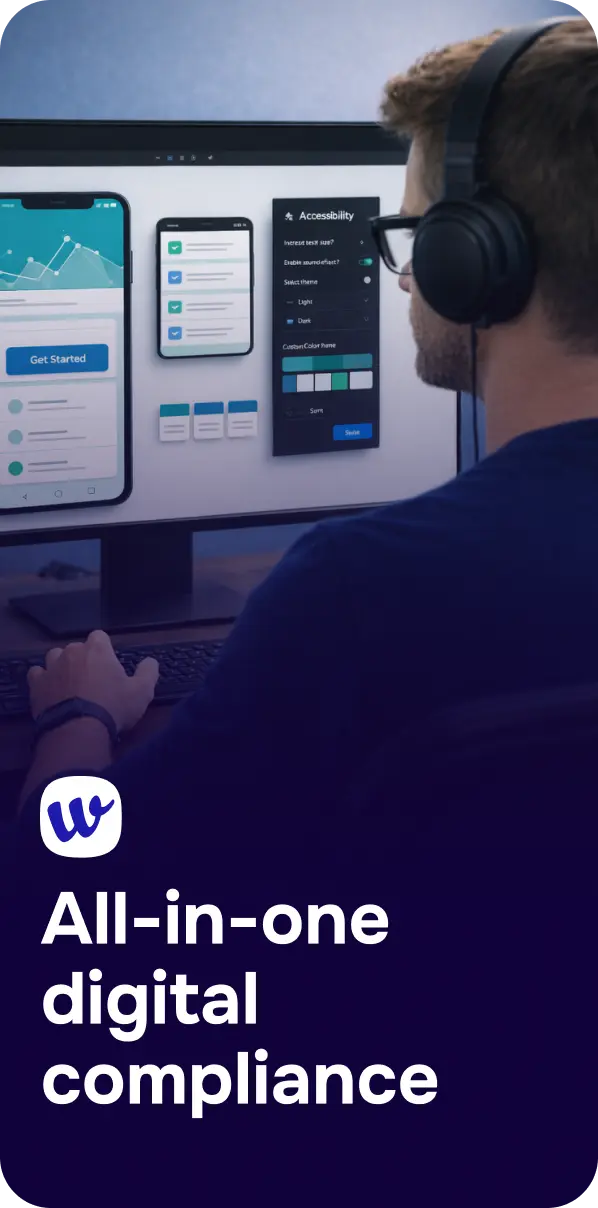
As the European Accessibility Act (EAA) comes into focus for digital teams, many businesses are asking a practical question: can a free accessibility widget help with compliance, or is a full audit required?
The short answer is that an accessibility widget and a full audit serve very different purposes. A widget may provide visitor-facing tools or interface adjustments, but EAA readiness is a broader obligation tied to how a digital experience is built, tested, maintained, and documented over time.
For teams evaluating accessibility widget EAA compliance, the key is understanding the gap between a visible front-end tool and a real accessibility program. If your goal is to reduce regulatory risk, support users effectively, and stay aligned with evolving standards, a widget alone is unlikely to be enough.

The EAA raises the stakes for organizations that offer digital products and services in the European market. It shifts accessibility from a nice-to-have initiative into an operational and compliance issue that affects product, legal, privacy, design, engineering, and digital experience teams.
That is why surface-level fixes can create a false sense of security. If a business assumes that adding a free widget solves accessibility barriers, it may overlook deeper issues in code, structure, forms, navigation, media, or user flows.
EAA readiness is better understood as an ongoing process: assess, fix, monitor, and improve. That aligns more closely with a full audit and continuous compliance workflow than with a single script placed on a website.
An accessibility widget is typically a front-end layer added to a website. It may offer controls such as text resizing, contrast changes, focus highlights, or other user-adjustable settings. In some cases, it can improve convenience for certain visitors.
Widgets can play a role in a broader accessibility strategy, especially when they are part of a larger platform that also supports compliance operations. For example, Corpowid positions its approach around a unified platform for accessibility, cookie consent, and legal compliance, rather than treating accessibility as a single isolated add-on.
Still, it is important to be clear about what a widget does not automatically provide:
If you want a closer look at how a multi-purpose front-end layer can fit into a wider compliance strategy, see Inside the 4-in-1 Widget: Accessibility, Consent, Legal and Company Info in One Script.
A full accessibility audit is designed to evaluate whether a digital experience presents barriers to people with disabilities and where those barriers exist. Unlike a widget, an audit looks beneath the visible interface and examines how the experience actually functions.
An audit typically examines the underlying implementation of key pages, templates, and interactions. That includes areas such as navigation, forms, headings, alternative text, keyboard access, focus order, error handling, and interactive components.
This matters because many accessibility issues are not solved by visual controls. They are rooted in how a page is coded and how assistive technologies interpret that code.
The EAA is not just about isolated pages. Real compliance risk often appears in critical flows such as account creation, checkout, booking, support, consent management, or document access. A full audit helps teams identify barriers across the journeys that matter most.
An audit should help teams understand what to fix first, which issues are likely to affect users most, and how remediation can be integrated into product and development workflows. That makes it more actionable than a simple front-end overlay.
Accessibility is not static. New releases, content changes, third-party tools, and design updates can introduce fresh issues. A strong compliance approach includes monitoring and repeated checks rather than relying on a one-time implementation.
This is one reason automated support is becoming more important for digital teams. For more on that shift, see AI Agents Are Here: How Autonomous AI Will Quietly Take Over Your Accessibility To-Do List.

While businesses often search for a simple yes-or-no answer, EAA readiness is better approached as a practical compliance standard for digital accessibility. In practice, that means organizations should be prepared to show that accessibility has been addressed in a meaningful, systematic way.
That generally points to expectations such as:
In other words, the EAA is about accessibility outcomes and operational readiness, not just the presence of a toolbar or badge on the screen.
Yes, but only when its role is understood correctly.
A widget may help provide extra usability controls or make certain information easier for visitors to access. It may also support transparency when used as part of a broader compliance layer. But it should not be treated as a substitute for accessibility testing, remediation, and ongoing governance.
The risk is not that widgets are always useless. The risk is that they are sometimes marketed or interpreted as complete compliance solutions when they are only one visible piece of a much larger requirement.
For EAA-focused teams, the more useful question is not “Should we have a widget or an audit?” but “How does each tool fit into a complete accessibility compliance process?”
They sit on top of the experience and offer visitors controls or shortcuts.
They identify where the experience itself creates barriers and what needs to change underneath.
They are easy to notice because users can see them immediately on the page.
They address the code, content, structure, and workflows that determine whether a digital service is actually accessible.
They may complement a broader accessibility program.
They are far closer to what organizations need when preparing for EAA obligations and broader accessibility compliance expectations.
Accessibility does not exist in a vacuum. For many organizations, the same teams managing accessibility are also dealing with cookie consent, privacy disclosures, legal notices, and technical site governance. Managing these obligations in separate tools can create fragmentation, duplicated work, and inconsistent oversight.
Corpowid’s positioning is built around solving that challenge with one AI platform for accessibility, cookie consent, and legal compliance. That unified approach is especially relevant for organizations that want to reduce operational complexity while staying ready for changing requirements.
Accessibility teams also often overlap with privacy and consent responsibilities, especially on public-facing websites. If that is part of your scope, you may also find How to Run a Cookie Audit on Your Website in 5 Steps useful.
If your organization currently relies on a free accessibility widget, start with an honest internal review. Ask questions such as:
If the answer to several of these is no, then a widget is probably functioning as a partial tool, not a complete compliance response.
For most businesses, the strongest path is not choosing between convenience and compliance. It is combining user-facing tools with deeper auditing, remediation, and monitoring in one operational framework.
That means:
This is where an all-in-one platform can create practical value. Instead of handling accessibility, consent, and legal obligations in silos, teams can work from a more unified compliance lifecycle.
A free accessibility widget is not the same as EAA compliance. It may support usability and contribute to a broader digital compliance setup, but it does not replace a full accessibility audit or an ongoing remediation process.
If your business is preparing for the EAA, the safest assumption is simple: visible controls are helpful, but compliance depends on the accessibility of the actual experience underneath them.
For organizations that want to reduce risk and simplify compliance operations, the goal should be a complete system for auditing, fixing, monitoring, and maintaining accessibility over time.
No. A widget may offer useful front-end controls, but EAA readiness involves identifying and fixing accessibility barriers in the underlying digital experience.
A widget adds user-facing interface options. An audit evaluates the actual website or digital service for accessibility issues and helps guide remediation.
Yes. A widget can support users and transparency when it is part of a broader accessibility and compliance program. It should not be treated as the whole solution.
Websites and digital products change constantly. Without ongoing monitoring, new accessibility issues can appear after updates, content changes, or third-party integrations.
Free accessibility widgets can be useful for quick interface adjustments, but they are not all built the same. This honest comparison explains what to look for, where free tools help, where they fall short, and how to choose the right approach for accessibility and compliance in 2026.
Corpowid has been recognized by Gartner, a leading global research and advisory firm, for our innovation and performance in digital accessibility. These badges reflect our commitment to creating inclusive, AI-powered web experiences.




 TR
TR