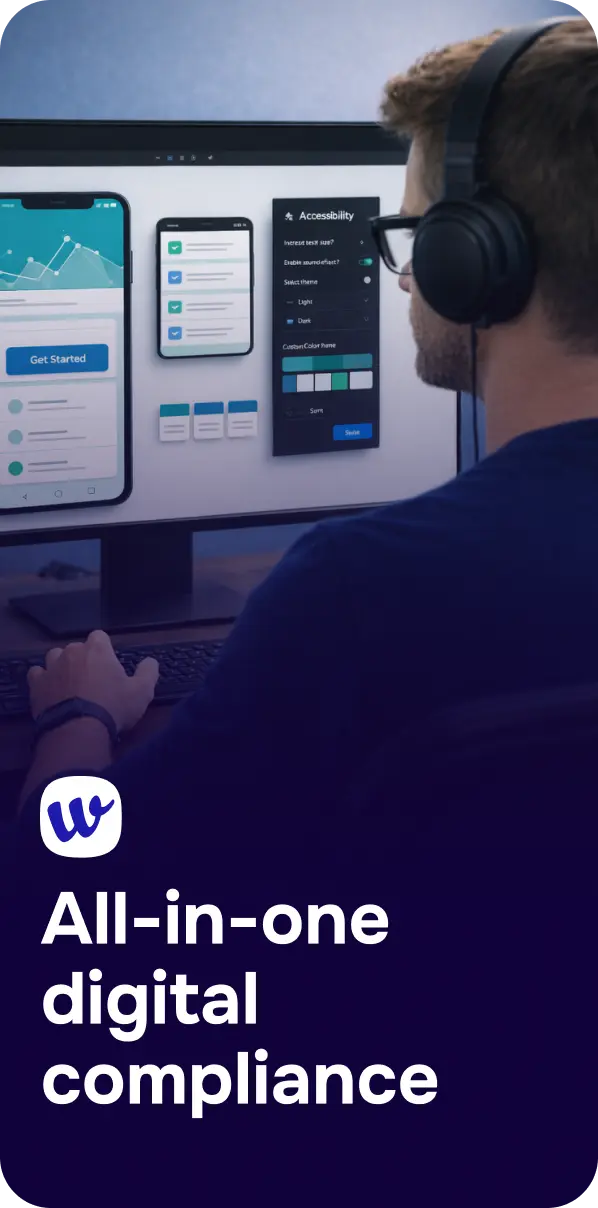
An accessibility widget is often one of the first tools organizations consider when trying to improve website accessibility quickly. That makes sense: widgets are visible, fast to deploy, and can provide immediate user-facing controls such as contrast adjustments, text sizing, or navigation aids.
But an important question remains: do accessibility widgets actually help? The honest answer is yes, in some situations. They can support usability for certain visitors and help teams address some common barriers faster. At the same time, they do not solve every accessibility issue, and they should not be treated as a complete substitute for auditing, remediation, monitoring, and ongoing accessibility governance.
For compliance, privacy, and digital teams, the best approach is a practical one: understand what a widget can do well, where it falls short, and how it fits into a broader accessibility program.

An accessibility widget is typically a front-end layer added to a website that gives users access to interface adjustments. Depending on the solution, those adjustments may include changing font size, increasing contrast, highlighting links, pausing animations, or enabling other viewing and navigation preferences.
The main value of a widget is speed and convenience. It can give visitors more control over how they experience a page without requiring them to change their device or browser settings. For organizations, it can also be a fast way to introduce visible accessibility support while broader improvements are underway.
This is one reason many businesses explore widgets early in their accessibility journey. They are relatively easy to understand, and they create a visible signal that accessibility is being taken seriously.
If your team is evaluating how a widget fits into a broader compliance experience, it may also help to review how a unified widget can combine accessibility, consent, legal and company information.
Widgets can be useful when they improve the experience for real users in practical, immediate ways. Their strengths usually fall into a few categories.
Many widgets allow visitors to change text size, contrast, spacing, or color presentation. For some users, these controls can make content easier to read and navigate.
This kind of flexibility can be especially helpful when a website has not yet fully optimized its design system for a wide range of user needs.
Some widgets provide features such as larger cursors, link highlighting, reading guides, or simplified navigation helpers. These tools may reduce friction for certain users, especially on content-heavy pages.
While these features do not repair underlying code issues, they can sometimes make an interface more manageable in the moment.
Accessibility improvements often take time. Design, development, QA, and content teams may all need to be involved. A widget can sometimes provide short-term support while more permanent remediation work is being planned or rolled out.
That can be valuable for organizations that need to start improving user experience quickly rather than waiting for a full redesign or development cycle.
A widget can also act as a clear, user-facing access point for accessibility options. That visibility may help some visitors discover available adjustments more easily than if they had to rely only on browser or operating system features.

This is where expectations need to stay realistic. A widget may improve parts of the experience, but it does not automatically make a website accessible or compliant.
If a page has missing labels, poor semantic structure, keyboard traps, inaccessible forms, broken focus order, or incorrect heading hierarchy, a widget usually cannot fully correct those issues at the source. These are often code, content, or design problems that require direct remediation.
Accessibility depends heavily on how a site is built. Surface-level controls cannot fully replace accessible markup, proper interaction patterns, and well-structured content.
Many of the most important accessibility barriers affect how assistive technologies interpret and interact with a website. If buttons are not properly named, dialogs are not announced correctly, or keyboard navigation breaks across components, a widget alone is unlikely to solve those deeper problems consistently.
This is one reason serious accessibility programs still rely on testing, including manual review where needed.
Widgets do not automatically make unclear content understandable. They also do not guarantee that images have meaningful alternative text, that documents are accessible, or that videos are properly supported for all users.
Accessibility is not just a technical layer. It also depends on content quality, authoring practices, and design decisions.
Organizations sometimes assume that installing a widget is enough to meet accessibility obligations. In practice, accessibility is ongoing. Websites change, new content is published, components are updated, and issues can reappear over time.
That is why monitoring and continuous improvement matter just as much as initial implementation. A good starting point for this broader view is understanding how AI can support ongoing accessibility work.
The most effective way to think about an accessibility widget is as one layer of support, not the whole solution.
A stronger accessibility program typically includes:
In that context, a widget can still play a useful role. It can improve the user experience, provide an immediate support layer, and complement technical accessibility work. But it works best when it sits inside a larger process rather than standing alone.
For teams managing multiple digital obligations at once, accessibility often overlaps with privacy, legal transparency, and site governance. That is one reason many organizations prefer platforms that centralize these responsibilities instead of treating them as separate one-off fixes.

If your organization is considering a widget, it helps to evaluate it based on outcomes rather than marketing promises.
Focus on practical questions. Does it make reading easier for some users? Does it offer controls that are genuinely useful? Is it easy to find and use? Does it support the experience without adding confusion?
A helpful widget should improve usability, not simply add another layer of interface complexity.
A widget should not distract from fixing root causes. Make sure your team still has a process for identifying issues, prioritizing them, assigning ownership, and verifying improvements over time.
If the widget becomes a reason to delay remediation, it is being used the wrong way.
The strongest solutions are usually connected to broader accessibility capabilities such as auditing, monitoring, automated fixes where appropriate, and reporting. That kind of ecosystem helps teams move from one-time setup to ongoing operational control.
Most digital teams are not only dealing with accessibility. They are also managing consent, privacy notices, legal documents, and website governance. Choosing tools that work well together can reduce fragmentation and make compliance operations easier to manage.
Even well-intentioned teams can overestimate what a widget will do. A few mistakes come up repeatedly.
This is the biggest one. A widget may help, but it is not a substitute for accessible design, accessible code, and ongoing testing.
Accessibility should be verified through auditing and monitoring, not assumed because a widget is live.
New releases, templates, plugins, and content updates can introduce fresh barriers. Accessibility requires continuous attention.
For many organizations, accessibility is part of a wider digital compliance program. Managing it in isolation can lead to duplicated work and inconsistent governance.
Yes, accessibility widgets can help. They can provide useful controls, improve usability for some visitors, and offer immediate support while deeper accessibility work is underway.
But they also have clear limits. They do not fix every accessibility barrier, they do not replace remediation, and they do not remove the need for testing and ongoing monitoring.
The most practical view is this: an accessibility widget can be a valuable component of an accessibility strategy, but not the entire strategy.
For organizations that want to reduce risk and improve digital accessibility in a sustainable way, the goal should be broader than simply adding a widget. It should be to build a repeatable system for identifying issues, fixing what matters, monitoring changes, and supporting users continuously.
That broader approach is where accessibility becomes operational, measurable, and far more effective over time.
EAA compliance software can speed up audits, monitoring, remediation, and reporting, but it cannot replace human judgment in every accessibility decision. Here’s where automation helps most and where expert review still matters.
Not all web accessibility solutions work the same way. This guide compares accessibility widgets, audits and full platforms so digital, compliance and privacy teams can choose the right approach for monitoring, remediation and long-term readiness.
Choosing among accessibility solutions can be difficult when every vendor promises compliance. This guide breaks down 8 practical questions to ask before you buy, so your team can evaluate fit, reduce risk, and choose a solution that supports long-term accessibility work.
Corpowid has been recognized by Gartner, a leading global research and advisory firm, for our innovation and performance in digital accessibility. These badges reflect our commitment to creating inclusive, AI-powered web experiences.






 TR
TR