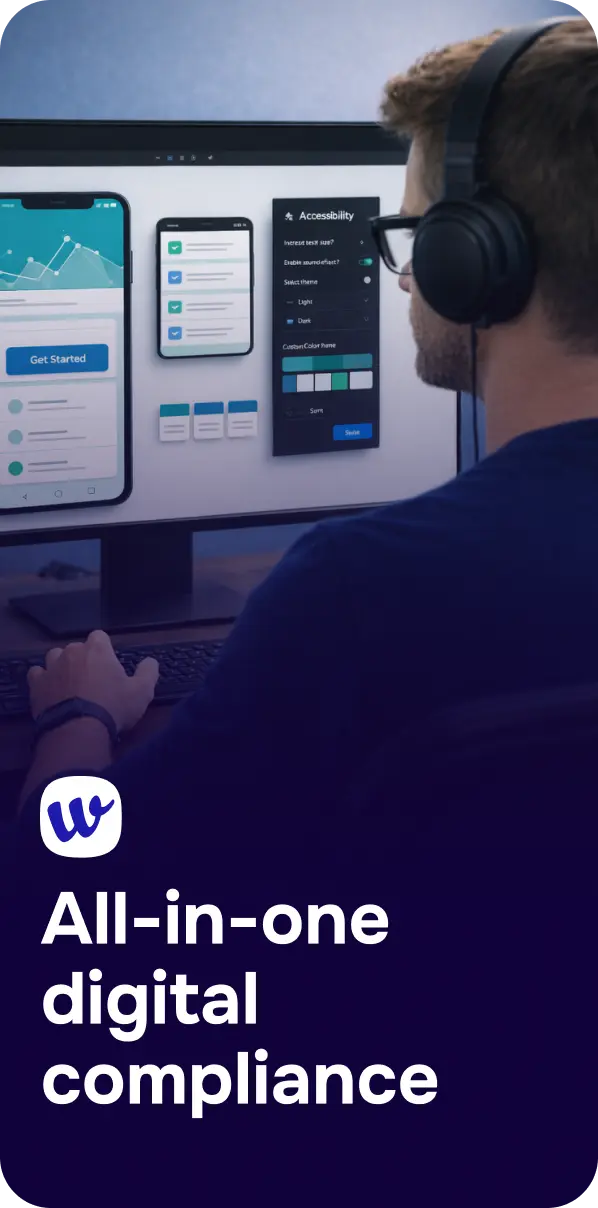
In the middle of the massive digital transformation we’re all navigating, we often forget to ask a fundamental, almost ethical question: Is this transformation actually including everyone?
The internet is no longer just a luxury; it’s the town square, the bank, the pharmacy, and the library all rolled into one. We shop there, we manage our life savings there, and we seek vital information there. But for a staggering number of people, the doors to this digital universe aren't just heavy—they are effectively locked.
Right now, over 1 billion people worldwide struggle with digital accessibility issues every single day. And let’s be clear: we aren't just talking about a small niche. This includes people with visual or hearing impairments, yes, but it also encompasses the "40+ demographic" facing age-related usability hurdles, individuals with motor skill limitations, people dealing with temporary injuries (like a broken arm), and even those facing significant language barriers. The data is sobering: 98% of the world’s digital assets are still not fully compliant with WCAG standards. This means nearly the entire digital world is operating with a "barrier to entry" for a massive chunk of the global population.
When an organization asks, "Are we accessible?", the answer shouldn’t be based on a "gut feeling" or a marketing claim. It is a strictly technical question with a strictly technical answer. That answer lives within the WCAG (Web Content Accessibility Guidelines).
Whether you’re looking at the newest Digital Inclusion regulations hitting the UK, or the landmark accessibility laws recently debated in the Georgian parliament, WCAG remains the gold standard. In Turkey, the Presidential Circular on Accessibility has officially moved this topic from the "social responsibility" pile to the "legal requirement" pile.
Competition in the accessibility market is healthy because it drives innovation, but there’s a unique catch here. When you buy a car, you can pick a "budget" or "premium" model—both will legally get you to your destination. In accessibility, that distinction doesn’t exist. A service either hits the WCAG benchmarks or it fails. There is no "lite" version of compliance that protects you from a lawsuit or a regulatory audit. You are either open to everyone, or you are excluding someone.
If you look at the current market, most companies offer "widgets"—those little accessibility icons you see stuck in the corner of a website. As we’ve emphasized in our previous deep-dives: no matter how fancy or "AI-powered" a widget claims to be, if it doesn’t fix the underlying source code, your platform is not 100% accessible. Using a widget to solve accessibility is like putting a fresh coat of paint over a structural crack in a wall. It looks better for a second, but the foundation is still failing.
Then, there’s the issue of "free" scanning tools. Most platforms use these as "lead magnets"—they want your email and phone number to put you in a high-pressure sales funnel. Typically, these tools are built on top of Lighthouse, Google Chrome’s default open-source tool.
Don't get me wrong: Lighthouse is a fantastic tool for general web performance and basic SEO. But for full WCAG compliance? It’s simply not enough. Lighthouse only scratches the surface; it’s the "smoke detector," not the full "fire inspection." It often misses complex code hierarchy errors, ARIA label mismatches, or accessibility gaps in dynamic, moving content. Relying solely on Lighthouse results is a gamble that can leave your brand exposed to massive legal and reputational risks.
We built www.scanandfix.com to be the antithesis of the "data-for-reports" model. Unlike almost every other player in the industry, ScanAndFix requires absolutely no registration and is 100% free. You don’t have to fill out a form, you don’t have to share your credit card, and you don’t have to wait for a sales call. You get a transparent, honest look at your website’s health instantly.
The real power of ScanAndFix lies in its depth. It doesn't just "run Lighthouse." It uses custom-built architectures and advanced algorithms specifically designed to catch the "invisible" errors that standard tools miss. Our mission is to give organizations a clear, unvarnished view of their status so they can pull themselves out of the "high-risk" zone before the regulators show up. If you want a professional report without a hidden agenda, it starts with an open, data-driven scan.
The biggest blind spot in the industry today is the obsession with websites while ignoring the rest of the digital footprint. An organization is an ecosystem, not just a URL.
Think about a major bank or a government agency. They might spend a fortune making their homepage accessible. But if their mobile app is a nightmare for screen readers, if their downloadable PDFs are just "images of text" that a computer can't read, or if their social media videos lack captions, are they truly accessible? Absolutely not. This is where we need to shift the conversation to "Total Digital Accessibility." True compliance isn't a checkbox for your website; it’s a commitment that spans your mobile apps (iOS & Android), your media files, your internal portals, and your digital-to-print documents (Printables).
So, how does a modern company actually solve this without losing their mind? It’s about moving accessibility "left"—meaning, you start at the very beginning of the project, not at the end. A true ecosystem approach follows this roadmap:
The Design Phase (Figma Plugin): Accessibility starts on the designer’s canvas. By using dedicated plugins, designers can catch color contrast issues or navigation flow errors before a single line of code is written. Fixing a mistake here costs pennies compared to fixing it after launch.
The Development Phase (Chrome Extensions & Core Analysis): Developers need tools that live where they work. They need to see errors visually in the browser and perform "visual journey" tests to ensure the logic of the site makes sense for a non-visual user.
AI-Powered Auto-Remediation: We aren't just talking about "detecting" errors anymore. Modern AI agents can now suggest brand-sensitive code fixes, generate high-quality alt-text for thousands of images in seconds, and create smart captions for video content.
Mobile-First Compliance: In a world where most traffic is mobile, ignoring the app store is a death sentence for accessibility. Apps need automated and manual testing throughout the development lifecycle to ensure they play nice with native screen readers like VoiceOver and TalkBack.
Document and Media Integrity: Every PDF, slide deck, or report your institution publishes must meet standards like PDF/UA. If a blind student or customer can't read your "Annual Report," you haven't finished the job.
The Command Center: You need one single management panel to track the health of your web, mobile, and document assets. If you can't measure it, you can't manage it.
Digital platforms are never "done." You’re constantly adding new pages, launching new campaigns, and updating content. This is why accessibility can't be a one-time project you do once a year. It has to be a living organism.
You need an infrastructure that stays active in the background—a "digital guardian" that watches every new upload and provides instant suggestions for improvement. Whether you're a local firm in Istanbul navigating Turkish standards or a global player meeting "Level A" requirements in the EU, you need a system that adapts to your specific regulatory environment without hitting you with "page limits" or technical roadblocks.
At Corpowid AI, we don’t look at digital accessibility as a "compliance headache." We see it as a fundamental tech revolution. It’s about baking intelligence and empathy into every line of code.
If you want your brand to be truly inclusive, you have to look past the superficial widgets. You have to embrace the ecosystem—the design, the code, the mobile apps, and the media. Because at the end of the day, making your digital world accessible isn't just about avoiding a fine; it’s about making sure that in the digital future, no one is left standing outside.
Small accessibility issues on product and checkout pages can create major friction for shoppers and compliance risk for businesses. Here are the e-commerce accessibility UX fixes that deserve attention first.
Choosing between an accessible HTML report and a tagged PDF affects usability, accessibility, maintenance, and compliance readiness. Here’s how to decide which format to publish and when a dual-format approach may be the better option.
Corpowid has been recognized by Gartner, a leading global research and advisory firm, for our innovation and performance in digital accessibility. These badges reflect our commitment to creating inclusive, AI-powered web experiences.






 TR
TR