Imagine needing to book a doctor’s appointment, refill a prescription, or read critical lab results—but the website won’t work with your screen reader, the buttons can’t be reached with a keyboard, or the text is so low‑contrast it’s unreadable. For millions of people, this isn’t hypothetical. It’s a daily barrier.
Online healthcare has become the front door to medical services. Portals, telehealth platforms, mobile apps, patient education sites, billing dashboards—healthcare lives online now. When those digital doors aren’t accessible, people are locked out of care. That’s why accessibility in online healthcare isn’t a “nice‑to‑have.” It’s a medical, legal, ethical, and business imperative.
This article explores why online healthcare should be accessible, the key digital accessibility laws and guidelines, and practical ways to design and build inclusive healthcare websites and mobile apps. We’ll keep it human, practical, and grounded in real‑world healthcare scenarios—because accessibility is about people first.
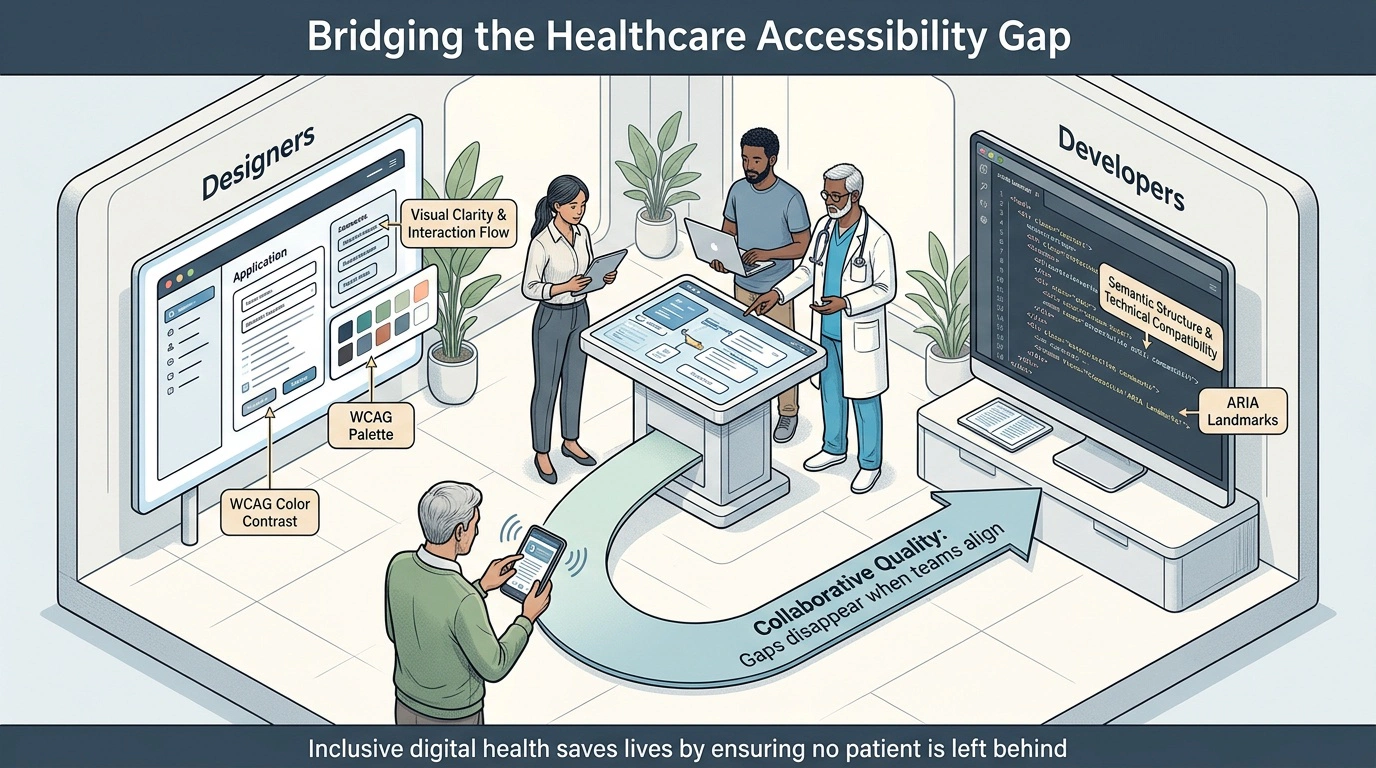
Accessibility in healthcare is about equity. When healthcare moves online, access moves with it—or disappears. Making online healthcare accessible ensures everyone can independently access care, regardless of disability, age, language, or temporary impairment.
Think about accessibility like curb ramps on sidewalks. They were designed for wheelchair users, but today they help parents with strollers, travelers with luggage, delivery workers, and people with injuries. Digital accessibility works the same way. When healthcare websites and apps are accessible, everyone benefits.
In healthcare, small barriers can create big risks. If a patient cannot read medication instructions because text can’t be resized, or a deaf patient misses critical information during a telehealth visit because captions aren’t available, the consequences aren’t just frustrating—they can be dangerous.
Accessible digital healthcare reduces miscommunication, supports informed consent, and helps patients manage conditions safely. It’s not just about compliance. It’s about preventing harm.
Disability isn’t rare. It’s part of the human experience. Visual, auditory, motor, cognitive, neurological, and speech disabilities affect a huge portion of the global population. Add temporary disabilities—like a broken arm—or situational limitations—like using a phone in bright sunlight—and accessibility suddenly becomes relevant to almost everyone.
Healthcare organizations that design only for “perfect” users are designing for a minority.
For many people, online healthcare isn’t a convenience—it’s the only realistic access point. People in rural areas, immunocompromised patients, older adults, and individuals with mobility challenges often depend on digital channels to receive care.
If digital healthcare isn’t accessible, these populations don’t just experience inconvenience. They experience exclusion.
Accessibility in healthcare isn’t only driven by ethics. It’s backed by strong legal frameworks. Understanding these laws helps healthcare providers, insurers, and digital health companies reduce risk while doing the right thing.
The Americans with Disabilities Act (ADA) is the cornerstone of accessibility law in the United States. Although written before today’s digital landscape, courts and regulators consistently interpret the ADA to cover websites and mobile apps—especially in healthcare.
Healthcare organizations are considered places of public accommodation. That means their digital services must be accessible to people with disabilities. Patient portals, appointment scheduling tools, telemedicine platforms, and informational websites all fall under this expectation.
ADA lawsuits related to inaccessible healthcare websites are rising. But focusing only on legal risk misses the bigger picture. ADA compliance aligns digital healthcare with its mission: serving all patients.
The Rehabilitation Act applies to federal agencies and organizations receiving federal funding—a group that includes many hospitals, public health programs, research institutions, and universities.
Section 508 requires electronic and information technology to be accessible. If a healthcare system uses federal funds and provides digital services, accessibility is not optional.
Section 504 goes even further, prohibiting discrimination based on disability in any program receiving federal assistance. An inaccessible patient portal can become a civil rights issue under this law.
HIPAA is often associated only with privacy and security, but accessibility intersects closely with HIPAA requirements. If accessibility barriers force patients to rely on others to access their health information, privacy is compromised.
Accessible authentication, readable content, and usable forms help patients manage their own information securely and independently. Accessibility and HIPAA aren’t competing priorities—they reinforce each other.
Section 1557 of the Affordable Care Act prohibits discrimination in healthcare programs, including discrimination based on disability. This section increasingly applies to digital health experiences.
If a healthcare website or app creates barriers for people with disabilities, it may violate ACA protections. As telehealth expands under the ACA framework, accessibility becomes a fundamental expectation, not an afterthought.
While laws define obligations, Web Content Accessibility Guidelines (WCAG) provide the “how.” WCAG is the global standard for digital accessibility and the framework most often referenced by courts and regulators.
WCAG is built around four core principles. Digital healthcare content must be perceivable, operable, understandable, and robust. In plain language, that means patients must be able to see or hear information, interact with it using different inputs, understand it clearly, and access it across devices and assistive technologies.
WCAG covers things like text alternatives for images, keyboard navigation, sufficient color contrast, clear headings, error identification in forms, and compatibility with screen readers. Following WCAG isn’t about ticking boxes—it’s about enabling real people to use healthcare services without barriers.
Instead of listing bullet points, let’s walk through ten practical, human‑centered ways to improve accessibility in digital healthcare—grounded in real use cases.
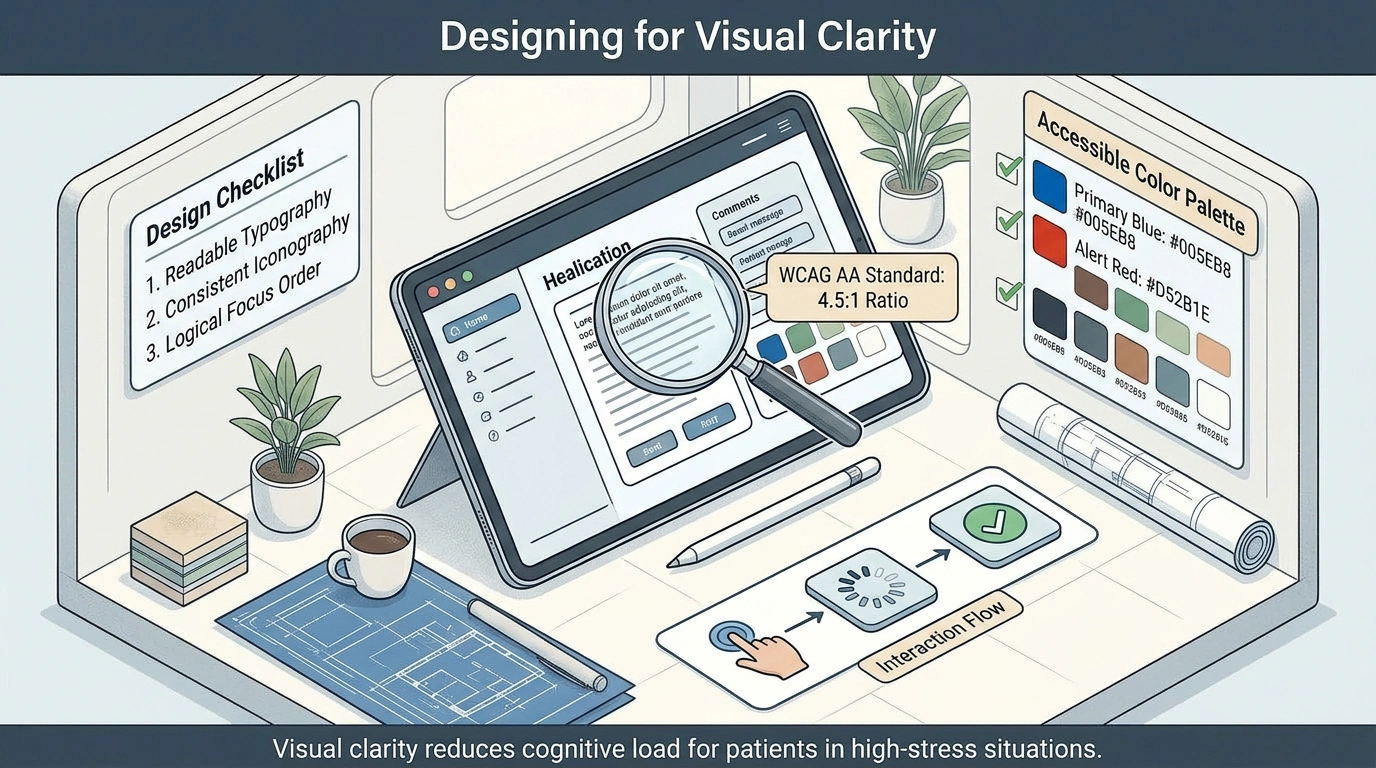
Medical language is already complex. Add unclear UX writing, and patients get lost fast. Accessible healthcare platforms use plain language, short sentences, and logical structure. This helps people with cognitive disabilities, non‑native speakers, and anyone dealing with stress or anxiety—which, let’s be honest, is most patients.
A patient shouldn't need to “guess” how to book an appointment or find test results. Consistent navigation, clear labels, and logical page structure help screen reader users, keyboard users, and seniors alike. Predictability builds trust—and reduces errors.
Not everyone uses a mouse or touchscreen. Some patients rely entirely on keyboards or switch devices. Every button, form field, modal, and menu in healthcare platforms must be operable without a mouse. If it can’t be reached with a keyboard, it isn’t accessible.
Low‑contrast text is one of the most common accessibility failures in healthcare portals. Light gray text on white backgrounds might look “modern,” but it’s unreadable for many patients. Proper contrast helps users with low vision, color blindness, and age‑related vision changes.
Screen readers only work well when websites are built semantically. Proper headings, labels, landmarks, and alternative text allow blind and visually impaired users to navigate healthcare content independently, from reading lab results to completing intake forms.
Healthcare forms are stressful enough. Accessible forms clearly label fields, explain errors, and don’t erase data when something goes wrong. Error messages should tell patients what happened and how to fix it—without blame or confusion.
Telehealth videos, patient education materials, and onboarding tutorials must include captions and transcripts. This helps deaf and hard‑of‑hearing users, patients in noisy environments, and people who process information better through reading.
Many patients access healthcare through mobile devices. Accessible mobile design means touch targets that are large enough, layouts that work in portrait and landscape, and compatibility with mobile screen readers like VoiceOver and TalkBack.
Patients should be able to adjust text size, zoom content, and change display preferences without breaking the interface. Flexibility supports diverse needs and empowers users to engage with healthcare on their own terms.
Accessibility isn’t theoretical. Healthcare organizations should test websites and apps using screen readers, keyboards, magnifiers, and real users with disabilities. Automated tools help—but they can’t replace human feedback.
Accessibility works best when it’s part of the design and development process—not a patch at the end.
Inclusive healthcare design begins at the planning stage. Accessibility requirements should be part of product roadmaps, design systems, and procurement decisions. When leadership treats accessibility as a core quality attribute—like security or performance—it shows.
Designers shape visual clarity and interaction flow. Developers ensure semantic structure and technical compatibility. When healthcare teams collaborate around accessibility, gaps disappear faster and quality improves across the board.
Patients trust healthcare providers with their most sensitive information. An accessible digital experience signals care, professionalism, and respect. Inaccessible platforms send the opposite message—even if unintentionally.
Beyond ethics and compliance, accessibility makes business sense. Accessible healthcare platforms reach more patients, reduce support costs, and improve satisfaction. When users can complete tasks independently, call centers get fewer requests and operations become more efficient.
Accessibility also future‑proofs healthcare organizations as regulations tighten and digital expectations rise.
Digital healthcare is evolving fast—AI‑powered diagnostics, remote monitoring, virtual care ecosystems. But innovation without inclusion creates a new kind of inequality. The future of healthcare must be built with accessibility at its core.
Inclusive design doesn’t slow innovation. It makes innovation sustainable, ethical, and scalable.
Accessible online healthcare isn’t optional—it’s foundational. It protects patients, aligns with laws, improves experiences, and strengthens healthcare systems as a whole. When digital healthcare works for everyone, care becomes safer, fairer, and more human.
Accessibility isn’t about lowering standards. It’s about raising them—so no patient is left behind at the digital door.
H3: Is digital accessibility required by law for healthcare websites?
In many cases, yes. Laws like the ADA, Rehabilitation Act, and ACA require healthcare organizations to provide accessible digital services, especially when those services are essential for care.
Does accessibility only help people with disabilities?
No. Accessibility benefits everyone, including seniors, people using mobile devices, patients under stress, and individuals with temporary injuries or limitations.
Are WCAG guidelines mandatory?
WCAG itself is not a law, but it’s widely used as the standard for measuring legal compliance with accessibility requirements.
Can accessibility be added after a website is built?
It can, but it’s more expensive and less effective. Building accessibility from the start leads to better outcomes and lower long‑term costs.
How often should healthcare platforms be tested for accessibility?
Regularly. Accessibility testing should be part of every major update, redesign, or new feature rollout.
If you want to make your healthcare platforms truly inclusive, Corpowid helps organizations deliver 360‑degree digital accessibility services—from audits and WCAG compliance to accessible design, development, and ongoing monitoring. Build healthcare experiences that work for everyone, without compromise.
The ADA Title II deadline extension may look like extra time, but for many public entities it mainly shifts pressure rather than removing it. Here’s why waiting can increase accessibility risk and what teams should prioritize now.
A year into the European Accessibility Act, businesses are moving from theory to operational readiness. Here’s what enforcement has actually looked like, where teams are getting caught out, and how to build a stronger accessibility process.
Corpowid has been recognized by Gartner, a leading global research and advisory firm, for our innovation and performance in digital accessibility. These badges reflect our commitment to creating inclusive, AI-powered web experiences.









 TR
TR