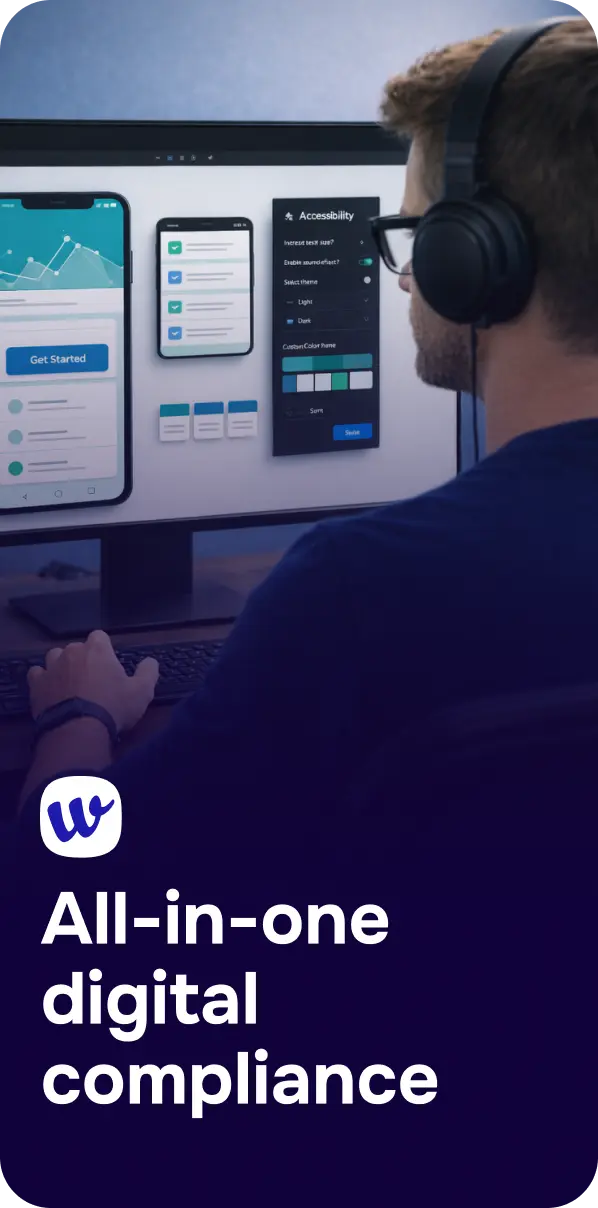
A global wave has been sweeping through the technology world in recent years—a concept with deep roots but one that has only recently reached its peak popularity: Digital Accessibility. Until recently, accessibility was often viewed as a mere gesture of "goodwill" or a corporate social responsibility project. Today, however, it has transformed into one of the most stringent legal and operational mandates that companies face.
The regulatory landscape is moving so dynamically that in the United States, the compliance deadlines for the widely impactful ADA (Americans with Disabilities Act) Title II were recently extended by one additional year from April 2026 to allow institutions adequate preparation time. This shift is not confined to the West either; from the Gulf countries to Georgia, new digital accessibility regulations and enforcement packages are being enacted one after another in emerging markets.
So, how are companies preparing their digital assets for this new era as the legal circle tightens? Unfortunately, the current picture is far from bright.
Today, the digital ecosystem—where billions of people conduct their daily lives—is riddled with invisible barriers for individuals with disabilities or special needs. Global web crawls and recent WebAIM (Web Accessibility in Mind) reports consistently reveal that over 98% of the homepages of the top 1 million websites contain at least one fundamental WCAG failure. The landscape on the mobile application side is even more dire, as the dynamic nature of mobile interfaces and screen reader integrations involve far more complex processes than traditional websites.
Globally, there is only one universally recognized constitution used to measure, audit, and standardize this compliance: WCAG (Web Content Accessibility Guidelines). Developed by the W3C (World Wide Web Consortium), this set of standards defines in clear terms exactly how a digital resource should be experienced by individuals with disabilities. To put it simply: for a button on your website to be perceived by a screen reader, it must have a proper accessibility label (aria-label), or an image must have alternative text (alt text) coded into the system to describe what it represents.
However, meeting these standards is not as straightforward as it sounds in theory. Companies looking to resolve this issue are generally forced to choose between two prevalent methods in the market: Overlay (Widget) Deployment or Digital Accessibility Auditing.
The ongoing debate surrounding "accessibility widgets" or "overlays" is currently one of the most heated topics in the digital industry. To be perfectly blunt, there are many radical opinions regarding these widgets within the community and among experts—the vast majority of which are negative. In fact, in some extreme circles, merely placing an accessibility widget on a website is dismissed as "accessibility washing" and is considered a toxic approach to inclusion.
The primary reason for this backlash is that such off-the-shelf widgets cannot fundamentally fix structural architectural errors deep within the source code. Furthermore, they are backed by a growing history of legal precedents proving that overlays do not make a user genuinely or fully compliant. To make matters worse, when it comes to mobile applications, you do not even have the luxury of installing a practical widget; the process requires heavy SDK integrations, extensive code optimizations, and lengthy approval cycles.
As a company, we offer one of the most robust and advanced accessibility widgets on the market today, and we are incredibly confident in our technology's capabilities. However, professional honesty and a realistic vision require us to admit one thing: No widget alone can make a digital asset 100% flawless and accessible.
If a widget is not enough on its own, the second alternative companies turn to is a Digital Accessibility Audit. However, this path presents corporations with massive operational bottlenecks of its own.
First, a large portion of the audits available in the market are superficial, consisting of simple automated reports that do not go beyond automated scanning tools. Even if you meticulously fix the findings in these reports on your website, you still have no guarantee of absolute legal compliance or a genuinely seamless user experience.
The second and most critical issue is the overwhelming task of refactoring and coding the massive list of errors that surface after an audit. From the perspective of an accessibility expert, fixing issues like a "missing alt tag" or an "insufficient contrast ratio" seems incredibly simple. However, for a standard developer or a content specialist whose sole job is to design, upload content, or build general software, these concepts belong to an entirely foreign language.
Not every company has an expert software team readily available to interpret these reports and immediately implement them into the codebase, nor do they have a niche digital agency to lean on for continuous support. More often than not, organizations cannot even decipher what "WCAG Level A" or "AA" actually means in the audit reports handed to them, leaving them unable to draw a roadmap or figure out where to begin. The result? Expensive, thick audit reports that end up sitting on a shelf gathering dust...
It is precisely to eliminate this operational paralysis, time crunch, and technical talent shortage that we developed a game-changing new module: AI FIX.
If your company is legally obligated to comply with regulations, operating under the shadow of hefty non-compliance fines, and most importantly, lacks the time or technical resources to resolve these issues manually in-house, AI FIX steps in. This module does not just detect accessibility issues on your digital assets; it automatically fixes the errors at the source and deploys the solution directly onto your website.
The magic here, however, lies in the fact that this is not a mechanical, robotic fix that a generic AI would perform. We define this approach as "Content-Sensitive".
Let’s illustrate what we mean with a concrete scenario: Imagine your website's homepage features three different service blocks side-by-side, and at the bottom of each block is a button that reads "Click Here for Details" to guide the user. A standard automated system or an inexperienced developer would simply add a generic label like "Button" or "Details" to all three buttons to satisfy the accessibility attribute. When a visually impaired individual using a screen reader navigates the page, they will hear the phrase "Click here for details, button" three consecutive times, leaving them completely unable to distinguish which button belongs to which service.
AI FIX, on the other hand, analyzes the context of the page, the design architecture, and the textual integrity. Instead of stamping the same generic label onto every button, it generates dynamic, content-aware descriptions:
For the button in Block A: "Click here to learn more about Cloud Solutions"
For the button in Block B: "Click here to learn more about Cybersecurity Services"
What does this visionary technology actually give corporations? First and foremost, you don’t just get a website that is "compliant on paper"; you get an inclusive platform that individuals with disabilities can truly experience without friction.
On an operational level, you minimize development costs and achieve massive time savings by compressing months of manual coding hours into minutes. With global regulations knocking on the door, it is time to stop viewing digital accessibility as a burden and transform it into a sustainable standard through the power of artificial intelligence.
Small accessibility issues on product and checkout pages can create major friction for shoppers and compliance risk for businesses. Here are the e-commerce accessibility UX fixes that deserve attention first.
Choosing between an accessible HTML report and a tagged PDF affects usability, accessibility, maintenance, and compliance readiness. Here’s how to decide which format to publish and when a dual-format approach may be the better option.
Corpowid has been recognized by Gartner, a leading global research and advisory firm, for our innovation and performance in digital accessibility. These badges reflect our commitment to creating inclusive, AI-powered web experiences.









 TR
TR