Accessibility for universities has quietly moved from a “nice‑to‑have” initiative to a defining measure of institutional quality. It affects who can apply, who can learn, who can stay, and who ultimately graduates. In a world where nearly everything in higher education—from admissions to lectures, exams, libraries, and mental‑health services—lives online, accessibility is no longer limited to ramps and elevators. It is digital, systemic, and unavoidable.
Yet here’s the paradox: while more students with disabilities are enrolling in higher education than ever before, most universities are still not designed with them in mind.
Let’s unpack what accessibility for universities really means today, why it matters at this particular moment, how recent shifts in ADA Title II enforcement impact higher education directly, and what universities must do next if they want to remain both inclusive and legally resilient.
In higher education, accessibility means that every student can access education on equal terms, regardless of physical, sensory, cognitive, neurological, or mental health conditions. It’s not about creating special pathways for “a small group.” It’s about building systems that work for real human diversity.
Accessibility spans digital platforms such as university websites and learning management systems, physical campus environments, teaching methods and assessments, and administrative processes like admissions and enrollment.
Accommodation is reactive. Accessibility is proactive.
Accommodation adds a temporary solution. Accessibility redesigns the system so the barrier never appears.
Education is fundamentally about access to knowledge. When a syllabus PDF can’t be read by a screen reader, the problem is not the student’s disability — it’s the design.
More than 20% of undergraduate students and over 10% of graduate students identify as having a disability. That is not a niche group — it is the classroom.
Mental health conditions, ADHD, learning disabilities, and anxiety are now the most commonly reported disabilities. Many students never formally disclose, which makes universal accessibility essential.
Universities are now held responsible not only for physical access, but for digital equality under the ADA, Section 504, and global accessibility standards.
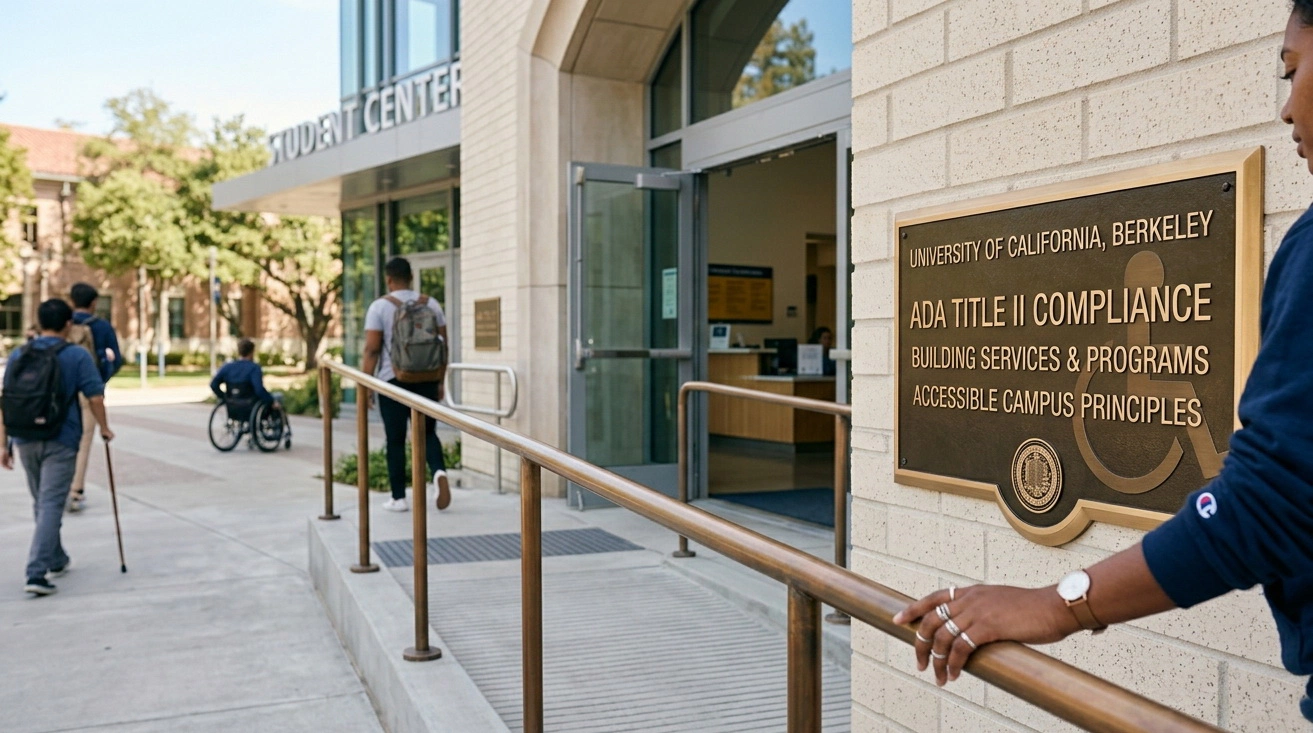
In April 2026, the U.S. Department of Justice extended the compliance deadlines for ADA Title II digital accessibility:
The technical requirement — WCAG 2.1 Level AA — did not change.
The American Association of People with Disabilities (AAPD) strongly criticized the extension, stating that governments and universities have had over 15 years of notice that digital accessibility is required. Extending the deadline, they argue, rewards inaction while students remain excluded.
The obligation to provide accessible digital services remains fully in force.
The delay does not pause risk, lawsuits, or complaints.
University websites are no longer brochures. They are learning environments, service hubs, and enrollment gateways.
Yet more than 96% of education websites still contain WCAG failures, often in basic areas like contrast, structure, and keyboard navigation.
Images without alt text, scanned PDFs, inaccessible forms, mouse‑only navigation, low‑contrast text — each one silently blocks students.
Canvas, Moodle, Blackboard, and Brightspace support accessibility — but only when content creators follow accessible practices. Faculty behavior often creates the barrier, not the platform.
Most university PDFs are inaccessible by default. Screen readers cannot interpret images of text, broken reading order, or missing tags.
Accessible content follows a clear hierarchy, logical reading order, proper heading structure, and descriptive links.
Captions are not optional. They support deaf students, non‑native speakers, students with ADHD, and anyone studying in real‑world environments.
Accessible classrooms, libraries, dorms, and labs communicate belonging. Inaccessible spaces communicate exclusion — even when unintentional.
Large campuses without accessible transportation systems turn learning into logistics.
When application portals are inaccessible, students do not fail — systems filter them out.
If assessment tools are inaccessible, universities measure endurance instead of ability.
Clubs, orientations, student events, and campus communication must also be accessible. Belonging does not end after class.
Clear instructions, predictable structures, and flexible deadlines are increasingly essential.
Screen readers, speech‑to‑text tools, Braille displays, magnification software — accessibility must accommodate real student technology.
Accessibility improves working conditions for aging faculty, injured staff, and neurodivergent educators.
Accessibility cannot live in a single department. It must be embedded across teaching, IT, communications, and procurement.
Multiple ways to engage, learn, and demonstrate understanding benefit all students.
Without ownership, documentation, and monitoring, accessibility becomes reactive and fragile.
Structured accessibility programs reduce legal exposure while increasing student success.
Multiple formats, multiple assessment options, flexible engagement — without lowering standards.
UDL removes friction from learning, not rigor.
Accessibility is expensive only when delayed. Building it early is far cheaper than retrofitting later.
AI and edtech amplify exclusion when accessibility is ignored.
Automation will shift accessibility from reactive remediation to continuous prevention.
Inclusive universities attract global talent, partnerships, funding, and trust.
Accessibility for universities is no longer a side initiative. It is the foundation of equitable education.
The ADA Title II extension gave institutions time — not permission to wait. Universities that act now will define the future of higher education.
Universities don’t fail at accessibility because they don’t care — they struggle because accessibility is complex, cross‑functional, and constantly evolving. That’s exactly where Corpowid comes in.
Corpowid helps universities build end‑to‑end, sustainable accessibility programs — not just temporary fixes. From ADA & WCAG audits to LMS accessibility, content remediation, AI‑powered monitoring, and governance frameworks, we support institutions at every stage of their accessibility journey.
Whether you’re preparing for ADA Title II compliance, modernizing legacy systems, or embedding accessibility into long‑term digital strategy, Corpowid partners with universities to make accessibility measurable, scalable, and future‑proof.
Let’s make higher education accessible — by design, not by exception. Discover how Corpowid can support your university today.
Why is accessibility critical for universities today?
Because over one in five students has a disability and many never disclose it.
Does the ADA Title II extension pause enforcement?
No. Obligations remain active.
Are private universities affected?
Yes. Under ADA Title III and Section 504.
Is accessibility only a digital issue?
No. It includes physical spaces, teaching methods, and services.
Where should universities start?
With audits, policy frameworks, faculty training, and continuous monitoring.
The ADA Title II deadline extension may look like extra time, but for many public entities it mainly shifts pressure rather than removing it. Here’s why waiting can increase accessibility risk and what teams should prioritize now.
A year into the European Accessibility Act, businesses are moving from theory to operational readiness. Here’s what enforcement has actually looked like, where teams are getting caught out, and how to build a stronger accessibility process.
Corpowid has been recognized by Gartner, a leading global research and advisory firm, for our innovation and performance in digital accessibility. These badges reflect our commitment to creating inclusive, AI-powered web experiences.









 TR
TR