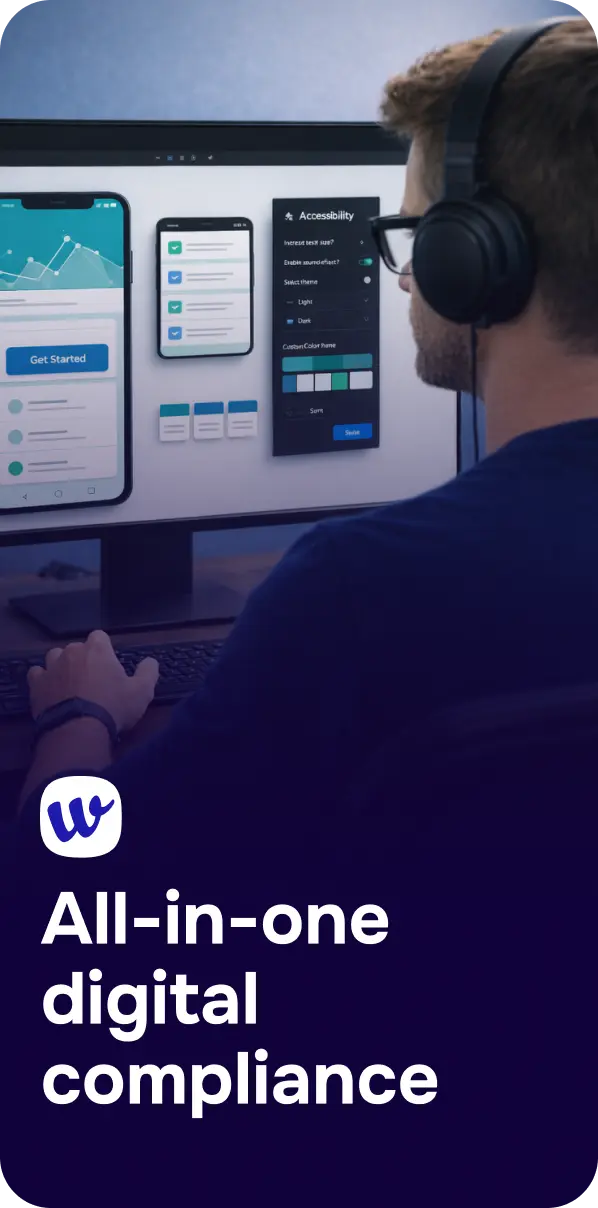
Insurance is a high-stakes, high-urgency digital experience. Customers often arrive at an insurer’s website or app during stressful moments—after an accident, health event, home damage, or financial disruption. If your quote flow, claims portal, provider directory, or policy documents aren’t accessible, you’re not just creating friction—you’re potentially excluding people from essential services.
Digital accessibility means designing and building digital experiences that people with disabilities can perceive, understand, navigate, and interact with. For insurance companies, it’s also a compliance and risk-management issue. Many organizations align to the Web Content Accessibility Guidelines (WCAG), commonly targeting WCAG 2.1 AA (and increasingly WCAG 2.2 AA) as a defensible standard.
Insurance companies serve broad, diverse audiences, including older adults, people with temporary impairments (like a broken arm), and customers with permanent disabilities. Accessibility improvements often translate directly into better business outcomes:
Accessibility litigation and settlements have shaped expectations across digital services. For context on how accessibility requirements can become very real, see Netflix and Closed Captions: A Landmark Accessibility Settlement—a reminder that digital barriers can carry regulatory and legal consequences.
Insurance platforms are complex: multi-step forms, authentication, document uploads, calculators, maps, portals, and dynamic dashboards. That complexity makes certain WCAG requirements especially critical.
Forms are the heart of insurance transactions—and a common source of failure. Typical issues include missing programmatic labels, placeholder-only instructions, unclear required fields, and error messages that aren’t announced to screen readers.
Insurance relies heavily on documents—policy booklets, explanation of benefits, claim letters, renewal notices, ID cards. When PDFs are image-based, missing tags, or have incorrect reading order, they become unusable with screen readers and difficult for keyboard-only users.
Customer portals often introduce accessibility barriers: CAPTCHA challenges, session timeouts, focus traps in modals, and dynamic content updates that aren’t announced.

Insurance support happens across channels: phone, video consultations, webinars, and chat. Accessibility includes providing captions for video content, transcripts for audio, and chat interfaces that are keyboard and screen-reader compatible.
WCAG is the baseline, but inclusive design helps you anticipate real-world conditions: cognitive load during emergencies, mobile use outdoors, low bandwidth, and multilingual audiences.

Accessibility succeeds when it’s treated as an ongoing program—not a one-time remediation sprint. Here’s a pragmatic approach that works well for insurers with multiple web properties, portals, and vendors.
Start by listing key journeys and mapping them to business risk and customer impact:
Automated testing quickly flags issues like missing alt text, low contrast, and form label problems, but it won’t catch everything (for example, whether link text makes sense out of context). Pair automation with manual testing using keyboard-only navigation and screen readers.
Platforms like Corpowid (corpowid.ai) can help insurance teams run automated accessibility audits and monitoring across public sites and portals, making it easier to track regressions and prioritize fixes release over release.
Insurance organizations often have design systems powering many experiences. Remediating a few shared components—inputs, error banners, modals, tables, accordions—can eliminate issues at scale. Ensure components have:
Don’t limit the scope to webpages. Build an accessible document workflow with templates, tagging guidance, and QA checks for every new policy PDF or claim letter. This is where many insurers unintentionally exclude users.

An accessibility statement builds transparency and creates a clear feedback channel for customers who encounter barriers. It should include supported standards (e.g., WCAG 2.1 AA), known limitations, contact methods, and response timelines. Corpowid (corpowid.ai) also supports generating and maintaining accessibility statements so updates don’t fall through the cracks as websites change.
Insurance teams often consider overlays or widgets as a fast solution. Widgets can be helpful for specific user preferences (like text size adjustments), but they don’t replace fixing underlying code, document accessibility, or form logic. If you’re evaluating this route, review Free Accessibility Widget: What It Can (and Can’t) Do for WCAG Compliance to understand where overlays fit—and where they don’t.
Many customers manage insurance primarily on mobile, especially for roadside assistance, digital ID cards, claim photos, and status updates. Apply WCAG-aligned testing to mobile UI patterns: dynamic type, screen reader labels, focus order, and accessible gestures. A useful starting point is Mobile App Accessibility Audit: A Practical WCAG-Based Checklist. If your insurance team shares infrastructure with banking-style apps (authentication, payments, secure portals), you may also benefit from patterns discussed in Mobile App Accessibility Audit for Banks: A Practical WCAG Guide.
Insurers rely on third parties for identity verification, payment processing, chat, document signing, mapping, and claims tools. Accessibility should be part of procurement and ongoing vendor governance. Request VPATs/ACRs, but verify claims through testing—especially for core workflows your customers can’t avoid. For a deeper look at automated documentation vs. real validation, see How AI Is Changing VPAT Creation—and Where Human Review Still Matters.
Digital accessibility for insurance companies isn’t just about meeting WCAG—it’s about making critical services usable in moments that matter. By prioritizing high-impact journeys, fixing component patterns, ensuring document accessibility, and monitoring continuously, insurers can reduce risk while delivering a smoother experience for everyone.
Small accessibility issues on product and checkout pages can create major friction for shoppers and compliance risk for businesses. Here are the e-commerce accessibility UX fixes that deserve attention first.
Choosing between an accessible HTML report and a tagged PDF affects usability, accessibility, maintenance, and compliance readiness. Here’s how to decide which format to publish and when a dual-format approach may be the better option.
Corpowid has been recognized by Gartner, a leading global research and advisory firm, for our innovation and performance in digital accessibility. These badges reflect our commitment to creating inclusive, AI-powered web experiences.








 TR
TR