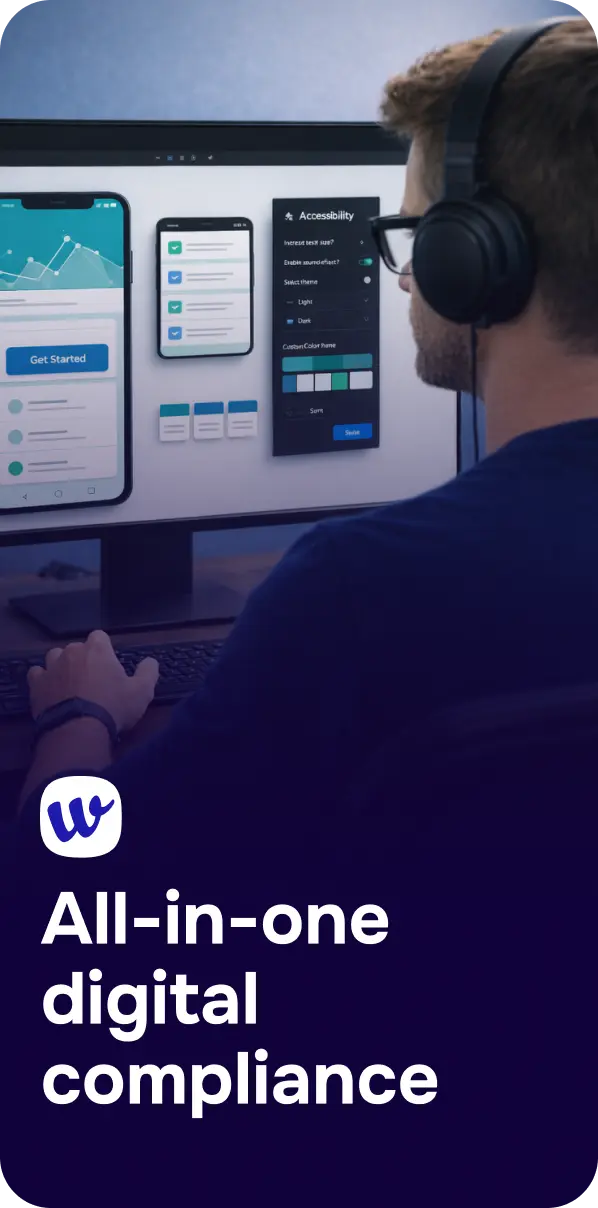
For banks, mobile apps are now the primary customer touchpoint for checking balances, transferring funds, paying bills, and managing cards. When that experience isn’t accessible, it doesn’t just exclude customers with disabilities—it increases operational risk, support costs, and the likelihood of complaints and legal exposure. A mobile app accessibility audit for banks is the most reliable way to identify barriers, prioritize fixes, and demonstrate due diligence toward accessibility compliance.
This article explains what an audit should cover, how to test iOS and Android banking features against WCAG expectations, and how to turn findings into measurable improvements.
Banking apps are used in high-stakes contexts: time-sensitive payments, fraud alerts, account recovery, and identity verification. If a customer can’t read a one-time passcode screen, use biometric fallback options, or understand an error message, they may be effectively locked out of their finances.
Accessibility is also increasingly linked to enforcement trends and public scrutiny. While cases vary by region and law, high-profile digital accessibility actions show that organizations can face major costs for inaccessible digital experiences. For perspective on how enforcement can reshape priorities, see Target’s $6 Million Accessibility Settlement That Changed E-Commerce, and for the broader compliance message from European actions, review Vueling Fined €90,000 for Website Accessibility Violations: What It Means for WCAG Compliance and Carrefour Faces €10,000 and Daily €500 Fines Over Accessibility Violations.
WCAG was written technology-agnostically and is widely used as the benchmark for accessibility expectations, even when the product is a native app rather than a website. In practice, a bank’s mobile accessibility audit typically maps app behaviors to WCAG 2.1 or 2.2 success criteria (often targeting Level AA), plus platform-specific guidance (Apple Human Interface Guidelines for accessibility and Android accessibility best practices).
Key areas where WCAG concepts show up in mobile banking include:
A strong audit combines automated checks with expert manual testing. Automation catches patterns quickly (missing labels, contrast issues in static screens), while manual testing validates real user flows (enrollment, login, transfers, card controls, customer support chat).
Start with the screens and flows that represent the greatest customer impact and compliance exposure. For most banks, that includes:
Testing should reflect real-world usage. At minimum, validate on:
Also test with common customer scenarios: one-handed use, bright sunlight, low connectivity, and older devices where performance can affect accessibility (e.g., lag impacting focus changes).

Automated tools can quickly flag issues like insufficient contrast or missing accessibility labels, but banking apps often fail in nuanced interactions—custom controls, animated transitions, masked inputs, and complex tables for transaction history.
Many banks use an accessibility platform to centralize audits and ongoing monitoring across digital properties. Corpowid (corpowid.ai), for example, can support structured accessibility audits and monitoring so teams can track issues over time and reduce regression risk as the app evolves.
Below are recurring barriers in mobile banking apps and practical remediation approaches.

An audit should produce more than a list of bugs. Banks need evidence that accessibility is being managed like any other risk-controlled domain.
It can also help to align documentation with broader industry expectations for regulated experiences. Accessibility programs in similarly high-stakes sectors like healthcare emphasize repeatable processes and clear accountability; see Digital Accessibility for Healthcare Providers: WCAG Compliance and Inclusive Patient Care for useful parallels.
Banking apps ship frequently, and accessibility can regress when new UI components, third-party SDKs, or design updates roll out. To prevent “audit-and-forget,” mature teams build accessibility into:
As apps incorporate more AI-driven personalization and automation, the accessibility surface area grows (generated content, conversational UI, adaptive workflows). That’s why forward-looking teams are tracking the intersection of AI and accessibility, including the risks of opaque interactions and unpredictable UI states discussed in Agentic AI: The Big Tech Story of 2026—and the New Accessibility Imperative.
Using a platform like Corpowid (corpowid.ai) can help teams keep audits, monitoring, and remediation workflows organized, making it easier to prove progress over time and reduce the odds of regressions slipping into production.
A mobile app accessibility audit is one of the fastest ways a bank can improve customer experience while strengthening compliance posture. When accessibility is treated as a continuous practice—supported by clear standards, repeatable testing, and ongoing monitoring—it becomes a competitive advantage as well as a safeguard.
Small accessibility issues on product and checkout pages can create major friction for shoppers and compliance risk for businesses. Here are the e-commerce accessibility UX fixes that deserve attention first.
Choosing between an accessible HTML report and a tagged PDF affects usability, accessibility, maintenance, and compliance readiness. Here’s how to decide which format to publish and when a dual-format approach may be the better option.
Corpowid has been recognized by Gartner, a leading global research and advisory firm, for our innovation and performance in digital accessibility. These badges reflect our commitment to creating inclusive, AI-powered web experiences.








 TR
TR