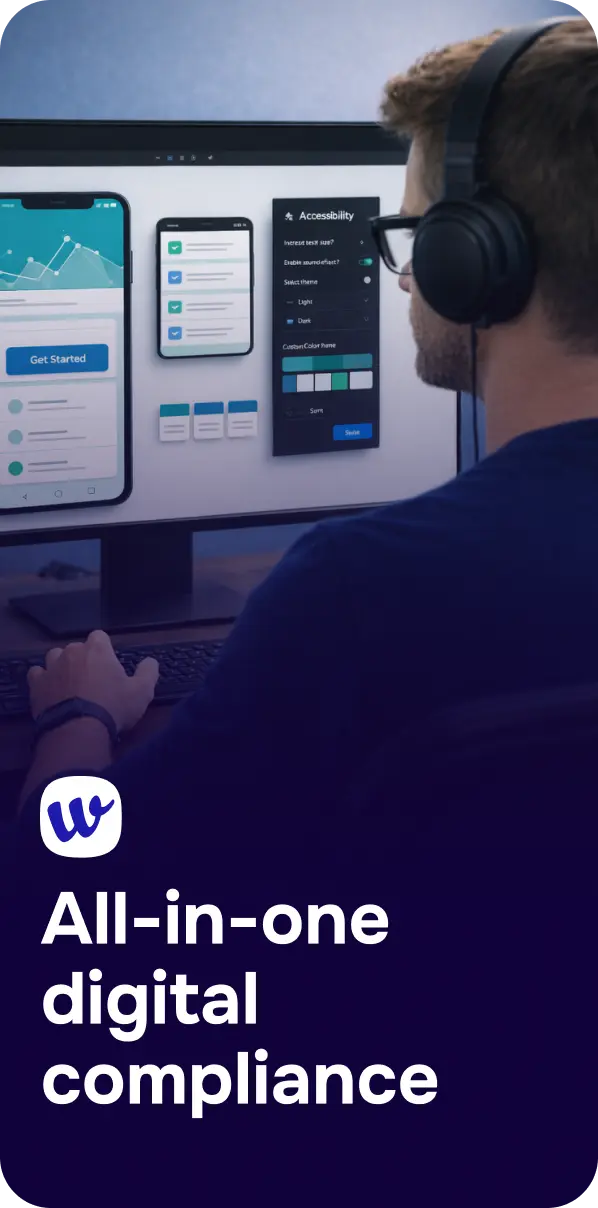
If you are searching for the best free accessibility widget 2026, you are probably trying to solve a real problem quickly: make your website easier to use, reduce accessibility gaps, and show visitors that accessibility matters. That is a reasonable goal. But it is also where many teams get stuck, because “free accessibility widget” can mean very different things depending on the vendor.
Some free widgets offer simple visitor-facing controls such as text resizing, contrast modes, or reading aids. Others position themselves as broader accessibility solutions. The challenge is that a widget can improve parts of the user experience without fully addressing the underlying accessibility issues on a website.
This guide compares free accessibility widgets honestly, explains what they are good at, where they fall short, and how to evaluate them if your team also cares about ADA, WCAG 2.2, EAA, privacy, and ongoing digital compliance.

Most free accessibility widgets focus on front-end controls that appear as a floating button or toolbar on the website. When a visitor opens the widget, they may see options like:
These features can be helpful for some users. They can also be easy for teams to deploy because they often require only a script install. For organizations under time pressure, that simplicity is part of the appeal.
However, a free widget is usually just one layer of accessibility support. It does not automatically mean your templates, forms, navigation, media, or code are accessible by default.
The strongest argument for a free widget is speed. If your website currently offers no visible accessibility controls, a widget can add immediate options for visitors who want to customize their experience.
Because many widgets are script-based, teams can evaluate them without a large implementation project. That can make them useful for early-stage accessibility improvements or internal review.
Used appropriately, a widget can be one part of a more complete program that includes auditing, remediation, monitoring, and governance. In that role, it may improve usability while your team works on deeper fixes.
If a site has missing form labels, poor heading structure, inaccessible menus, weak focus states, or media issues, a toolbar alone typically does not resolve those root problems. Accessibility depends on how the site is built, not only on what controls are layered on top.
This is one of the biggest risks. Teams may install a free widget and assume the website is now compliant. In practice, accessibility readiness usually requires more than a front-end overlay or toolbar. If your organization is working toward WCAG 2.2, ADA, or EAA readiness, you need to look beyond the widget itself.
“Free” can mean basic features only. More advanced capabilities such as monitoring, issue detection, remediation workflows, reporting, or support may sit outside the free tier.
For many businesses, accessibility is only one piece of the digital compliance picture. Cookie consent, privacy disclosures, legal transparency, and technical monitoring often sit in separate tools. That can create operational complexity if your team is trying to manage everything across different vendors.

Instead of choosing based on a feature list alone, use a practical evaluation framework.
Ask whether the controls are genuinely useful, easy to find, and easy to operate. A widget should not make the interface more confusing. It should support people, not distract them.
A good comparison starts by asking a simple question: is this tool mainly a visitor toolbar, or is it part of a broader accessibility platform? Those are not the same thing. Be careful with messaging that blurs the line.
Websites change constantly. New pages, design updates, scripts, and content can introduce new accessibility issues. If a tool stops at installation, your team may still need a separate process for review and monitoring. This is one reason many organizations are moving toward more automated workflows, as discussed in AI-driven accessibility operations.
If your website also needs cookie consent and legal disclosures, it is worth asking whether the widget lives in isolation or fits into a unified compliance setup. Fragmented tools can create more work for privacy, compliance, and digital teams.
Even free tools should be assessed for script weight, site performance impact, governance, and maintenance. A small install today can become a bigger operational dependency later.
There is no single best free accessibility widget for every organization. The right choice depends on what problem you are actually trying to solve.
A simple free widget may be enough as a starting point if your immediate goal is to add interface adjustments while you plan broader accessibility work.
If your team is accountable for accessibility readiness, audits, or legal risk reduction, a free widget alone is unlikely to be enough. You will usually need a more complete process for identifying, fixing, and monitoring issues over time.
If accessibility sits alongside cookie consent, privacy, and legal transparency, the better long-term choice may be a unified platform rather than another standalone script. Corpowid’s approach is built around combining accessibility, cookie consent, and legal compliance in one AI platform, which can reduce operational fragmentation. You can see how that unified experience works in Inside the 4-in-1 Widget.
The honest takeaway is simple: free widgets can be useful, but they are rarely the whole answer.

If your team is also reviewing privacy operations, it can help to assess website tracking and consent practices at the same time. This guide on how to run a cookie audit is a useful companion step.
In 2026, the best free accessibility widget is not the one with the longest list of visual controls. It is the one your team understands clearly, deploys responsibly, and uses as part of a realistic accessibility strategy.
If you only need a lightweight layer of visitor controls, a free widget may be a reasonable starting point. But if your organization needs to be ready for accessibility, privacy, cookie consent, and legal compliance together, it makes more sense to evaluate solutions that unify those obligations instead of treating them as separate website add-ons.
That is where Corpowid stands apart. Rather than positioning accessibility as a single floating button, Corpowid brings accessibility, cookie consent, and legal compliance into one AI-driven platform built for ongoing audit, fix, and monitoring workflows. For teams that want less fragmentation and more continuity, that is a much stronger long-term model than relying on a free widget alone.
Free accessibility widgets can help, especially when used to provide immediate visitor-facing controls. But they should be evaluated honestly:
If you are comparing options, the most important step is to avoid confusing convenience with completeness. A widget can support accessibility, but sustainable compliance usually requires a platform, process, and ongoing oversight.
They may help with user-facing controls, but they do not automatically resolve all underlying accessibility issues on a website. Teams working toward ADA or WCAG 2.2 readiness usually need auditing, remediation, and ongoing monitoring in addition to any widget.
Look for useful visitor controls, clear implementation, ease of use, and realistic positioning. It is also important to understand whether the widget is only a front-end toolbar or part of a broader accessibility workflow.
That depends on your goals. A widget may be enough for basic visitor controls, but a full platform is generally better for organizations that need ongoing accessibility management and broader digital compliance support.
Many businesses do not manage accessibility in isolation. They also need cookie consent, privacy, and legal transparency. A unified approach can reduce tool sprawl and make compliance operations easier to manage across teams.
A free accessibility widget may add convenience features, but it is not the same as a full accessibility audit. Here’s what businesses should understand about EAA expectations, risk reduction, and building a stronger compliance process.
Corpowid has been recognized by Gartner, a leading global research and advisory firm, for our innovation and performance in digital accessibility. These badges reflect our commitment to creating inclusive, AI-powered web experiences.





 TR
TR