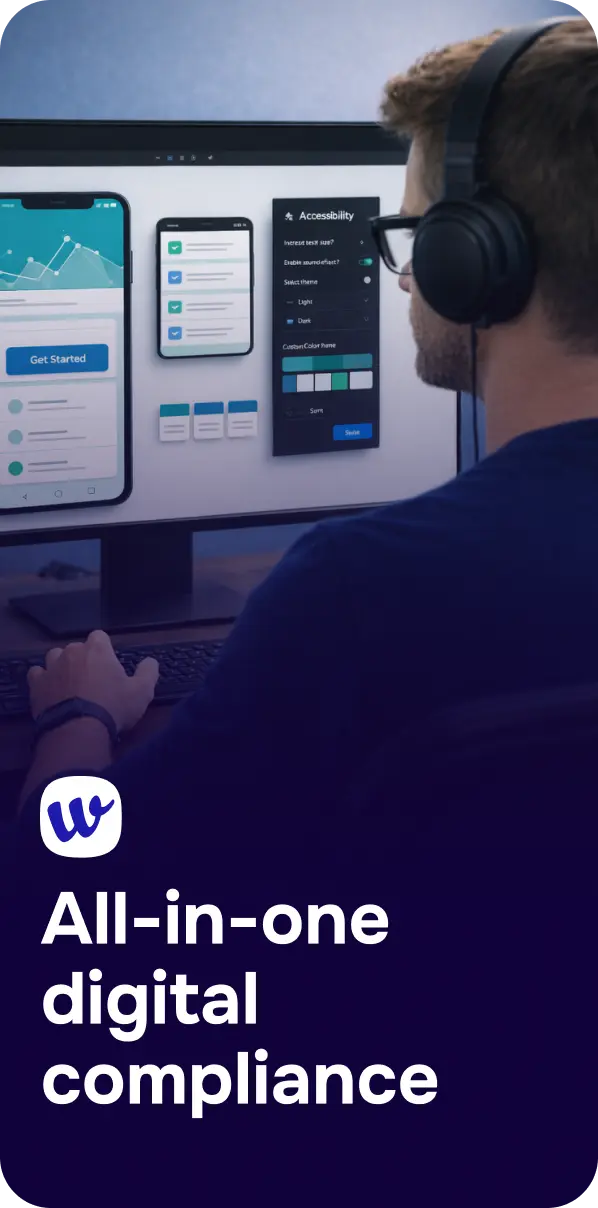
For multi-market brands, accessibility work becomes more complex the moment content, interfaces, and user journeys expand across languages. A website may serve customers in English, Spanish, French, German, Arabic, or many other languages, but the accessibility experience still needs to remain clear, usable, and consistent for every visitor.
That is where a multilingual accessibility widget can play an important role. Instead of managing disconnected experiences for each market, digital teams can support users across regions from one centralized panel while combining accessibility tools, monitoring, and remediation into a more manageable workflow.
In practice, this matters for global marketing teams, privacy teams, compliance leaders, and product owners who need to reduce friction without creating separate operational silos for every locale.

Accessibility is not only a design or development concern. For organizations serving multiple countries or language groups, it is also an operational challenge. Visitors need to understand controls, navigate content, and use assistive support in a language that matches their experience.
If accessibility tools are only available in one language, the result can be confusing. A visitor may land on a localized website but encounter accessibility controls, labels, or support options in a different language. That mismatch can reduce usability instead of improving it.
A multilingual approach helps brands:
For organizations already balancing privacy, legal, and accessibility obligations, centralization is especially valuable. A single platform approach can simplify what would otherwise become a fragmented process across countries and business units.
Not every accessibility solution is built for multi-market delivery. When teams evaluate a multilingual accessibility widget, they should look beyond front-end appearance and focus on operational fit.
The most immediate requirement is straightforward: users should be able to interact with accessibility controls in the language of the site or market they are visiting. This creates a more intuitive experience and reduces friction for people who need quick access to support features.
As websites grow, teams need one place to manage accessibility performance instead of handling each domain, subdomain, or locale manually. A centralized panel helps teams monitor issues, review changes, and maintain consistency without switching between disconnected tools.
A widget can support users on the front end, but long-term accessibility maturity also depends on what happens behind the scenes. Continuous monitoring, AI accessibility auditing, and automated accessibility remediation help teams identify and address issues across websites and apps on an ongoing basis.
Accessibility does not exist in isolation. Many organizations also need accessibility statements, legal documents, reporting, and evidence they can share internally or externally. A solution that fits into broader compliance workflows can reduce duplication and help teams stay organized.
If you want to see how a unified interface can combine accessibility with other compliance functions, see Inside the 4-in-1 Widget: Accessibility, Consent, Legal and Company Info in One Script.

For a single-language site, manual oversight may still be possible. For a brand operating in 10, 20, or 40+ language environments, it becomes much harder to maintain visibility without centralized tooling.
One panel creates operational advantages that matter at scale.
Teams can review accessibility status from one dashboard instead of relying on separate local processes. This is especially useful when responsibility is shared across marketing, product, compliance, legal, and engineering teams.
Real-time AI accessibility monitoring helps surface accessibility issues continuously, rather than waiting for periodic manual reviews. That is important when content changes frequently across localized pages.
When issues are detected, automated accessibility remediation can help resolve the issues a platform is able to detect on websites and apps. This reduces repetitive work and supports a more continuous accessibility process.
Global teams are often asked to demonstrate what has been reviewed, fixed, or monitored. Compliance reporting helps make accessibility data more usable for internal stakeholders, procurement teams, and governance processes.
This centralized model also pairs well with specialist activities such as manual accessibility testing for VPAT and ACR work, where teams may need both automated insight and expert validation.
Even organizations with strong digital teams can run into accessibility gaps when they expand across markets. Some of the most common issues include:
These challenges often grow over time because each new market adds content, templates, scripts, and workflows. A fragmented setup can make it difficult to know which issues are isolated and which are systemic.
That is why many organizations move toward a platform model that combines accessibility auditing, monitoring, remediation, legal document management, and reporting in one place.
For enterprise and multi-market teams, accessibility is often part of a larger digital compliance program. The same websites and apps that need accessible experiences may also need cookie consent controls, policy hosting, consent records, and exportable compliance documentation.
When these needs are handled separately, teams can lose time coordinating vendors, reconciling reports, and maintaining multiple scripts or dashboards. A more unified approach can help reduce that operational burden.
For example, a business managing accessibility across markets may also need localized privacy and consent experiences. Corpowid's broader platform includes cookie consent management, cookie scanning and monitoring, cookie policy generation, consent records management, legal document management, and compliance reporting alongside accessibility capabilities.
That does not mean every organization needs to deploy everything at once. But it does show why a multilingual accessibility widget is often most valuable when it is part of a wider, centralized compliance workflow.
For teams also reviewing website consent practices, this related guide may help: How to Run a Cookie Audit on Your Website in 5 Steps.

If your organization is comparing solutions, a practical checklist can help keep the evaluation grounded in day-to-day needs.
For many teams, the goal is not simply to add another front-end feature. It is to create a repeatable, scalable process for supporting users and reducing accessibility risk across a growing digital estate.
Organizations interested in more automated workflows may also want to read AI Agents Are Here: How Autonomous AI Will Quietly Take Over Your Accessibility To-Do List.
A multilingual accessibility widget helps solve a very practical problem: how to support users across languages without creating separate accessibility operations for every market. For multi-market brands, that can improve consistency, simplify oversight, and make accessibility work more manageable at scale.
The strongest approach is usually not a standalone widget alone, but a connected system that includes auditing, monitoring, remediation, reporting, and legal-compliance support from one panel. For digital teams working across regions, that kind of centralization can make accessibility easier to maintain as websites, apps, and market demands continue to grow.
A multilingual accessibility widget is a user-facing accessibility tool that supports visitors in multiple languages, helping them access accessibility features in the language that fits their website experience.
Brands serving multiple regions need accessibility experiences that match localized websites. Without multilingual support, users may encounter accessibility controls in the wrong language, which can create confusion and reduce usability.
A widget can support users, but many organizations also need accessibility auditing, continuous monitoring, remediation, reporting, and documentation as part of a broader accessibility and compliance strategy.
One panel gives teams a centralized place to monitor issues, review accessibility performance, manage remediation, and support reporting across multiple websites, apps, or language versions.
A single accessibility audit can reveal important issues, but modern websites and apps change too fast for one report to stay reliable. Here’s why continuous accessibility monitoring matters and how teams can build a more durable compliance process.
Audit-ready evidence matters when privacy, accessibility, and compliance teams need to show what was collected, monitored, fixed, and documented. Here’s how proof of consent and accessibility reporting can be organized for fast, on-demand export.
Corpowid has been recognized by Gartner, a leading global research and advisory firm, for our innovation and performance in digital accessibility. These badges reflect our commitment to creating inclusive, AI-powered web experiences.




 TR
TR