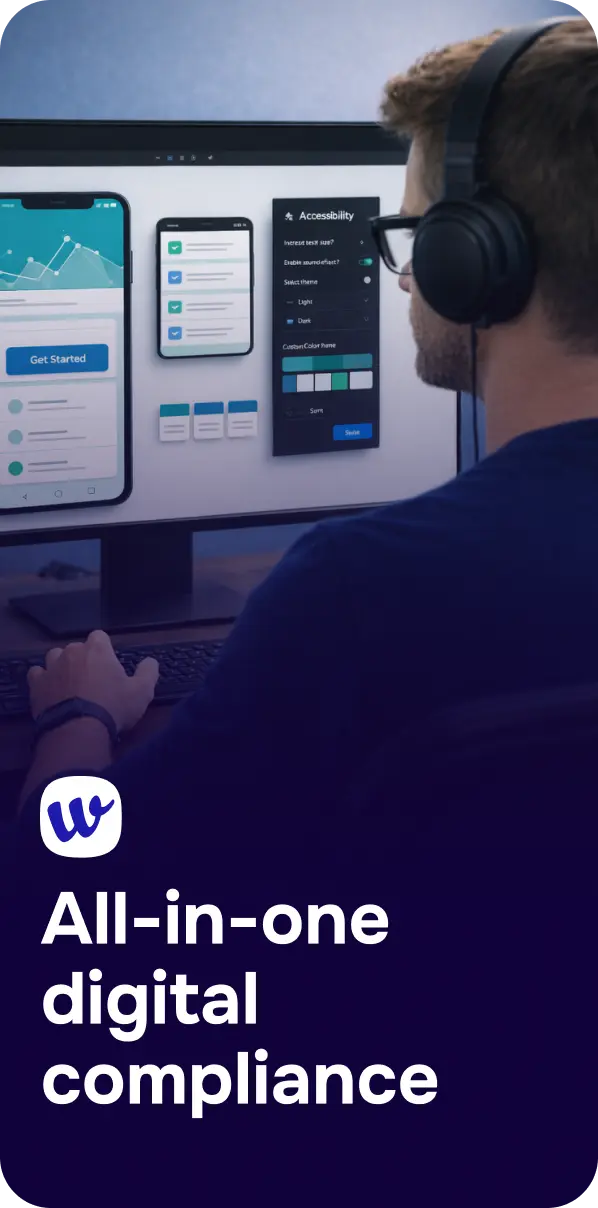
For many teams, adding an accessibility widget feels like a practical first step. It is fast to deploy, visible to visitors, and easy to explain internally. But when organizations rely on that widget as the main accessibility strategy, problems start to surface.
That is the core issue behind many accessibility overlay lawsuits. A visible toolbar or overlay may change some on-page controls for users, but it does not automatically fix the underlying code, content, navigation patterns, forms, media, or workflows that create barriers in the first place.
If a website still has inaccessible menus, unlabeled buttons, poor keyboard navigation, missing form instructions, or content that does not work well with assistive technology, the presence of a widget does not remove the risk. In practice, it can create a false sense of completion.
For compliance, privacy, and digital teams, the lesson is not that every widget is useless. It is that a widget alone is not a complete accessibility program. Sustainable accessibility requires auditing, remediation, monitoring, and governance across the full digital experience.

Accessibility lawsuits generally focus on whether people with disabilities can actually use a website or digital product. That means the legal and practical question is not, “Was a widget installed?” but rather, “Could users access the content and complete key tasks?”
When overlays are treated as a shortcut to compliance, they often leave major gaps behind. Common examples include:
These are not cosmetic issues. They affect whether users can browse, understand, and complete actions on the site. If those barriers remain, the organization may still face complaints, legal scrutiny, and reputational damage.
One of the biggest failures is strategic, not technical. Teams may install a widget and assume they are now covered for WCAG, ADA, EAA, or broader website legal compliance needs. But accessibility standards apply to the experience itself, not just to a layer placed on top of it.
A widget may offer controls such as text resizing, contrast adjustments, or reading aids. Those features can be helpful for some visitors. However, they do not guarantee that the site structure, code, content, and user journeys are accessible by default.
That distinction matters. Accessibility should be built into the website, not outsourced to a single interface element.
Many accessibility barriers originate in templates, components, design patterns, and content publishing habits. If headings are used incorrectly, buttons are not coded properly, modal windows trap keyboard focus, or error messages are unclear, a widget does not usually solve those root causes.
This is why point-in-time fixes are rarely enough. Digital accessibility requires teams to find issues, prioritize them, remediate them in the product, and verify that the experience works in real use.
Even when a site improves, accessibility is not a one-time project. New content, design updates, third-party scripts, campaign pages, and product releases can introduce fresh barriers. Without ongoing monitoring, websites can drift back into noncompliance.
That is especially important for organizations managing multiple domains, regional sites, or frequent publishing cycles. Compliance risk grows when there is no continuous process to audit, fix, and monitor changes over time.
Accessibility is broader than a toolbar. It includes page structure, navigation, language clarity, form usability, multimedia handling, mobile interactions, and compatibility with assistive technology. It also overlaps with privacy, consent, and legal transparency in ways many teams underestimate.
For example, if cookie banners, policy links, or legal notices are difficult to navigate, that can create friction not just for accessibility but for broader compliance as well. A fragmented approach often leaves these connected obligations unmanaged.

It is worth being fair here: a widget is not automatically a bad tool. In some cases, it can provide useful visitor-facing controls and improve discoverability of accessibility options. It may also support communication by showing that the organization is paying attention to the user experience.
Used thoughtfully, a widget can be one part of a broader accessibility and compliance framework. For example, it may help centralize certain controls or disclosures in a single interface. Corpowid discusses this broader approach in Inside the 4-in-1 Widget: Accessibility, Consent, Legal and Company Info in One Script.
But the key word is part. A widget should support the accessibility program, not replace it.
If your team wants to reduce risk around accessibility overlay lawsuits, the better approach is to treat accessibility as an operational discipline rather than a single installation task.
Start with a structured review of the website or product experience. Look at templates, navigation, forms, media, user flows, and high-traffic pages. Evaluate how the site works with keyboard navigation and assistive technologies, not just with visual checks.
The goal is to identify barriers in the actual experience, especially on critical paths such as account creation, checkout, lead forms, support, and consent flows.
Once issues are identified, remediation should happen where the problems originate: in code, design systems, CMS workflows, and content practices. This is what creates durable improvement. Surface-level controls are not enough if the underlying interface remains inaccessible.
Accessibility needs ongoing oversight. As regulations evolve and websites change, teams need a way to detect regressions, prioritize fixes, and maintain a current view of risk. That is why platforms that audit, fix, and monitor continuously are more aligned with real compliance work than one-time deployments.
Many organizations manage accessibility, cookie consent, and legal obligations in separate tools and workflows. That fragmentation can create blind spots. A more mature model brings these responsibilities together so teams can manage user-facing compliance in one place and operational controls behind the scenes.
For teams reviewing consent interfaces as part of website compliance, related governance steps are covered in How to Run a Cookie Audit on Your Website in 5 Steps.
At a deeper level, many overlay failures are not about one tool. They are about governance. Organizations often lack a repeatable system for deciding what standards apply, checking whether experiences meet those standards, assigning remediation ownership, and verifying that fixes stay in place.
When that governance is weak, teams naturally look for shortcuts. A widget becomes attractive because it appears to solve a complex problem quickly. But legal exposure usually comes from the unresolved barriers left underneath.
A stronger governance model includes:
This is also where AI-driven workflows can help teams move from reactive cleanup to continuous management. For a broader look at that shift, see AI Agents Are Here: How Autonomous AI Will Quietly Take Over Your Accessibility To-Do List.

If your website already has a widget, the right question is not whether to panic. It is whether that widget is backed by a real accessibility process.
Ask your team:
If the answer to most of these is no, then the widget is probably acting as a visible layer over unresolved compliance risk.
Accessibility overlay lawsuits are a reminder that visible tools do not equal accessible experiences. A widget may contribute to the solution, but it is not the solution by itself.
For businesses that need stronger website legal compliance, the safer path is to combine visitor-facing controls with continuous auditing, remediation, monitoring, and governance. That is how teams move from appearance to actual readiness.
In other words: if a quarter of sued websites already had a widget, the problem was never just the absence of a toolbar. The problem was relying on the toolbar instead of fixing the experience.
No. A widget can offer helpful user controls, but it does not automatically make a website compliant. Accessibility compliance depends on whether the site itself is usable and accessible across real interactions.
Yes. If underlying accessibility barriers remain, the presence of an overlay does not remove that risk. Legal and user concerns usually focus on whether people can access content and complete tasks successfully.
Not necessarily. A widget can still play a useful role if it is part of a broader accessibility strategy. The main issue is using it as a substitute for auditing, remediation, and ongoing monitoring.
They should assess the actual website experience, fix root issues in code and content, monitor changes continuously, and align accessibility work with wider privacy and legal compliance processes.
A one-time audit can reveal important technical SEO problems, but websites change constantly. Learn how technical SEO monitoring compares, what each method is best for, and why ongoing checks often uncover more issues over time.
An accessibility widget can support users and improve parts of the on-site experience, but it is not a complete compliance strategy by itself. Here’s what it can do, what it cannot do, and how businesses should evaluate it as part of broader accessibility work.
Running separate accessibility, cookie consent, and legal compliance widgets can add complexity to page performance and site governance. This article explains what to evaluate when comparing multiple scripts versus a unified compliance layer.
Corpowid has been recognized by Gartner, a leading global research and advisory firm, for our innovation and performance in digital accessibility. These badges reflect our commitment to creating inclusive, AI-powered web experiences.







 TR
TR