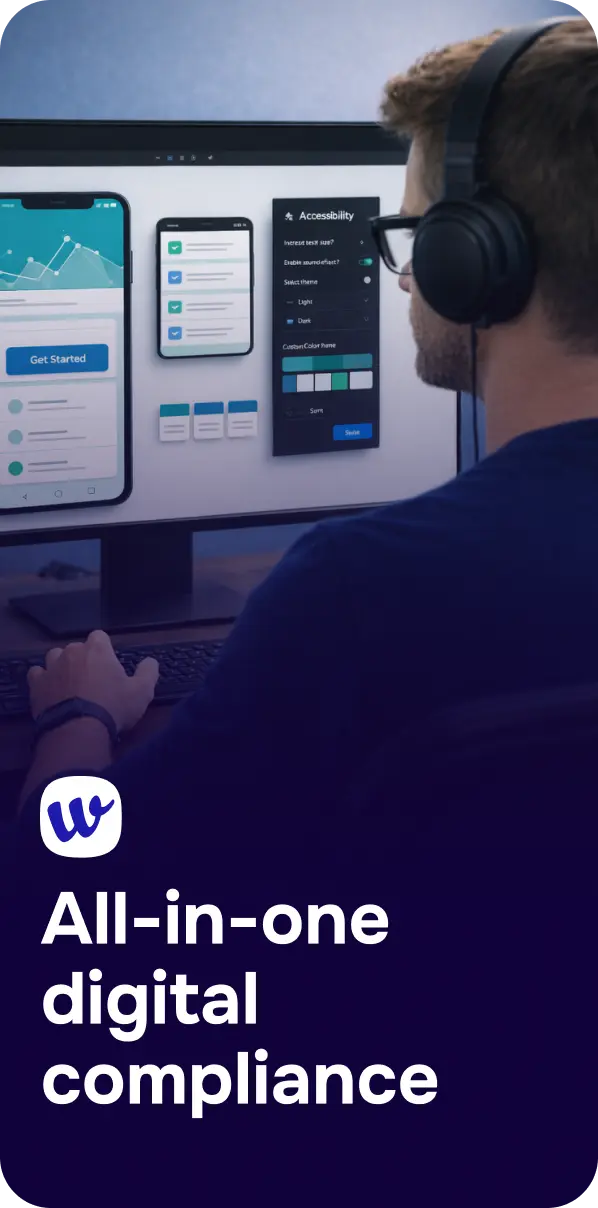
“Vibe coding” has become shorthand for building features by leaning heavily on AI-assisted generation and quick iteration—prompt, paste, ship, repeat. It feels productive because it often is: you can scaffold pages, rewrite components, and spin up entire marketing sites in hours. But the speed has a cost that’s easy to miss until users complain (or regulators do): hidden accessibility debt.
Accessibility debt is like technical debt, except it’s owed to real people. When a site is difficult or impossible to use with a keyboard, screen reader, switch device, voice control, or magnification, users are blocked. And when accessibility problems pile up across templates and components, remediation becomes expensive and disruptive.
AI can absolutely help you build accessible experiences—but only if you treat accessibility as a requirement, not a “nice to have.” As discussed in AI Accessibility Tools Need Guardrails — Not Blind Trust, the winning approach is pairing automation with clear standards, reviews, and testing.
Vibe coding tends to optimize for what looks correct in a visual browser at a single viewport size. WCAG, by contrast, is about operability, perceivability, understandability, and robustness across different users and assistive technologies.
The problem isn’t that AI “doesn’t care.” The problem is that prompts are often underspecified: “Make a modern hero section,” “Build a pricing table,” “Create a modal.” Unless you explicitly require keyboard support, semantic structure, accessible names, and states, you often get components that appear fine but fail in critical ways.
<div>-based layouts without correct headings, landmarks, lists, or form structure.aria-label, inputs without programmatic labels, or ambiguous “Click here” links.These issues frequently map to WCAG Level A/AA failures—meaning they are both high-impact and commonly required for compliance.
Vibe coding thrives on “looks right.” Accessibility requires “works right.” Many failures are invisible unless you test with assistive tech or follow a structured checklist.

AI might generate headings based on visual size rather than hierarchy, skipping from h1 to h4 or using headings purely for styling. Screen reader users rely on headings to navigate quickly. When the structure is wrong, the page becomes exhausting to understand.
A site can look beautiful and still be unusable if tab order is illogical, focus styles are removed, or interactive elements aren’t reachable. AI-generated UI often includes custom dropdowns or clickable cards implemented with non-interactive elements, breaking keyboard interaction.

AI-generated forms frequently show inline errors in red text below fields, but forget to link errors to inputs (e.g., aria-describedby) or to ensure messages are announced. The result: screen reader users submit, fail, and have no idea why.
Some AI-built sites add quick overlays without understanding their implications: scroll locking that breaks zoom, floating chat buttons that obscure content, or popups that don’t trap focus correctly. If you use an accessibility overlay, it should be part of a broader program—not a substitute for fixing code-level issues. Tools like Corpowid (corpowid.ai) can help you identify underlying WCAG failures through automated audits and monitoring so you can prioritize real fixes rather than masking problems.
Accessibility debt compounds because AI-generated components get reused. A flawed modal pattern can spread across dozens of pages. A broken button pattern can infect an entire design system. Eventually, remediation isn’t “fix one page”—it’s refactor the component library, update templates, retest, and redeploy.
It’s also getting riskier to ignore. The European Accessibility Act (EAA) is raising expectations for digital accessibility across consumer-facing products and services. If you’re tracking compliance implications, it’s worth reading The First EAA Lawsuits Have Landed — Lessons From France and Germany and EAA Fines by Country: What Non-Compliance Actually Costs. The takeaway: “We used AI” won’t be a defense if customers can’t use your site.
As AI systems become part of production workflows, governance matters. The intersection of accessibility and AI policy is evolving—see The EU AI Act and Accessibility: How They Intersect in 2026 for where accountability is headed.
You don’t have to abandon AI-assisted development. You need guardrails: standards, repeatable checks, and an accessibility definition of done.
When asking AI for components, include requirements such as:
WCAG isn’t static, and “we meet 2.1” can become outdated quickly. WCAG 2.2 adds improvements that particularly affect keyboard and touch users. For a clear explanation of what changes and why it matters, see WCAG 2.1 vs 2.2: Why You Should Adopt the New Baseline Now. If you’re vibe coding new UI patterns, build them to the newer baseline from day one.
Automation can reliably catch many recurring issues (missing alt text, low contrast in certain contexts, missing labels, broken heading structures, duplicate IDs, etc.). It won’t fully validate user flows, screen reader announcements, or the real usability of complex widgets.
A practical program looks like this:
Corpowid (corpowid.ai) supports this workflow by running automated accessibility audits and continuous monitoring so teams can see issues trending over time, catch regressions after releases, and maintain an up-to-date accessibility statement as improvements roll out.

Vibe coding is here to stay. The competitive advantage isn’t merely shipping quickly—it’s shipping quickly and responsibly. When you treat accessibility as a core engineering and design constraint, AI becomes an accelerator instead of a debt multiplier.
The best time to address accessibility is before patterns spread across your codebase. Add guardrails to prompts, build to modern WCAG expectations, and put repeatable checks in your delivery pipeline. You’ll reduce rework, lower legal risk, and—most importantly—make your site usable for more people from day one.
Corpowid has been recognized by Gartner, a leading global research and advisory firm, for our innovation and performance in digital accessibility. These badges reflect our commitment to creating inclusive, AI-powered web experiences.








 TR
TR