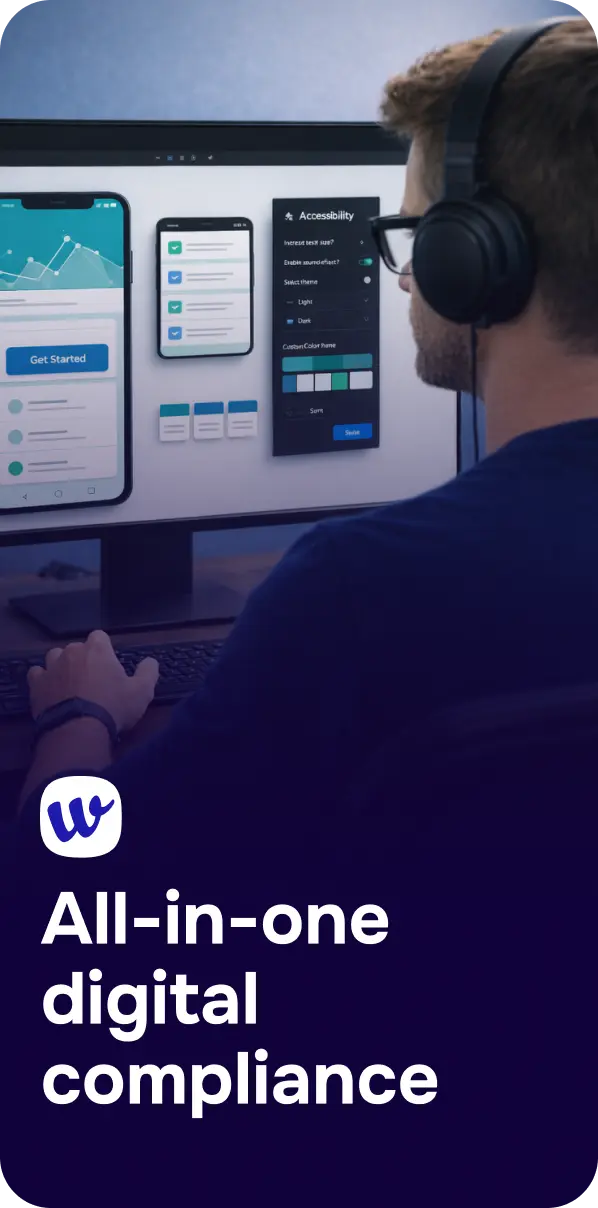
Agentic AI is poised to be the defining tech story of 2026: software that doesn’t just answer questions, but takes action on a user’s behalf. Instead of clicking through menus, users will delegate goals—“change my flight,” “apply for a plan,” “pay this invoice,” “summarize this article and save it”—and an AI agent will navigate workflows across pages, tools, and accounts.
For digital accessibility, this is both promising and risky. Promising because agentic experiences can reduce complexity and help people complete tasks with fewer steps. Risky because the “new UI” of agents—dynamic content, auto-filled forms, embedded assistants, and autonomous multi-step flows—can easily break WCAG expectations if it’s not built and governed intentionally.
Agentic AI refers to systems that can plan, decide, and execute multi-step actions toward a goal—often using tools like browsers, APIs, calendars, payment systems, and internal knowledge bases. Unlike a traditional chatbot, an agent:
In 2026, we’ll see agents embedded in everyday customer journeys: telecom upgrades, travel rebooking, retail returns, insurance claims, HR onboarding, and newsroom content workflows. That means accessibility can’t be an afterthought—agents will be part of “the website,” not a separate feature.
WCAG isn’t anti-AI. But it is explicit about perceivability, operability, understandability, and robustness. Agentic UX can challenge all four principles, especially when interfaces become highly dynamic and decisions are automated.
Agents often stream status updates (“Searching…”, “Found your booking…”, “Applying filter…”, “Submitting…”) and replace sections of the page without full reloads. If those updates aren’t exposed correctly, screen reader users may miss critical information or lose their place.

Agents will prefill forms, toggle options, and select plans. That can be great—until it creates hidden state changes, missing labels, or silent errors. Common pitfalls:
Inclusive design here means the user stays in control: show what changed, why it changed, and how to undo it—without relying solely on color, animation, or tiny toast notifications.
As agents become part of essential services, accessibility failures become more than “bugs”—they become barriers to equal access. Recent enforcement trends show regulators and courts are paying attention to digital experiences, not just static pages. For perspective, see Vueling’s €90,000 fine and what it signals for WCAG compliance and Carrefour’s fines and daily penalties tied to accessibility violations.
Agentic AI adds a twist: if your “assistant” prevents keyboard users from completing checkout, or if the agent’s modal traps focus, the barrier is still yours—regardless of whether the UI was AI-generated or assembled dynamically.
Teams can make agentic AI accessible if they treat it like any other mission-critical UI: designed, tested, monitored, and iterated with real users and assistive technologies.
Agents should not feel like magic; they should feel like guided automation. Provide a “plan view” that is readable and operable:
Agentic interfaces often rely on the same building blocks: dialogs, toasts, progress indicators, accordions, and stepper wizards. If these components aren’t accessible, the agent will amplify the problem across the whole journey.

Agentic AI will bring more voice-driven interactions, but voice is not a universal solution. Users may combine voice with keyboard, or use switch control, screen magnification, or alternative input methods. Ensure:
Agentic AI introduces continuous change: prompts evolve, tools change, UI layouts shift, and new agent skills get added. That volatility makes accessibility regressions more likely unless you implement ongoing governance.
Traditional audits can miss “agent-only” states—like intermediate confirmation panels, error fallbacks, and loading steps that only appear when the agent takes a particular action. Build test plans that include:
Platforms like Corpowid (corpowid.ai) can help by running automated accessibility audits and monitoring to catch recurring WCAG issues in templates and UI components that agentic flows reuse across journeys.
As agentic features roll out, your accessibility statement needs to reflect the real user experience, including known limitations and contact options. This becomes especially important in regulated environments and public-sector contexts. If you operate in Türkiye or serve Turkish users, align your approach with policy expectations outlined in Türkiye’s digital accessibility circular and WCAG alignment guidance.

Telecom flows involve identity verification, plan comparisons, device financing, add-ons, and support. Adding an agent can simplify decision-making—but only if it remains transparent and operable. If you’re building for this sector, see WCAG compliance patterns for telecommunications customer experiences to understand where barriers most often appear.
Agentic experiences in publishing may summarize content, adjust reading modes, curate feeds, or generate “topic briefings.” The accessibility risk is that personalization layers can disrupt heading structure, keyboard navigation, or reading order. For sector-specific considerations, refer to digital accessibility guidance for media and publishing companies.
Agentic AI will redefine what users consider “the interface.” In 2026, accessibility won’t be limited to pages and components; it will apply to decisions, automation, and the full end-to-end journey an agent executes. Organizations that treat accessibility as a core product requirement—supported by repeatable audits and monitoring (for example, with Corpowid (corpowid.ai))—will ship faster, reduce compliance risk, and deliver experiences that more people can actually use.
Small accessibility issues on product and checkout pages can create major friction for shoppers and compliance risk for businesses. Here are the e-commerce accessibility UX fixes that deserve attention first.
Choosing between an accessible HTML report and a tagged PDF affects usability, accessibility, maintenance, and compliance readiness. Here’s how to decide which format to publish and when a dual-format approach may be the better option.
Corpowid has been recognized by Gartner, a leading global research and advisory firm, for our innovation and performance in digital accessibility. These badges reflect our commitment to creating inclusive, AI-powered web experiences.







 TR
TR