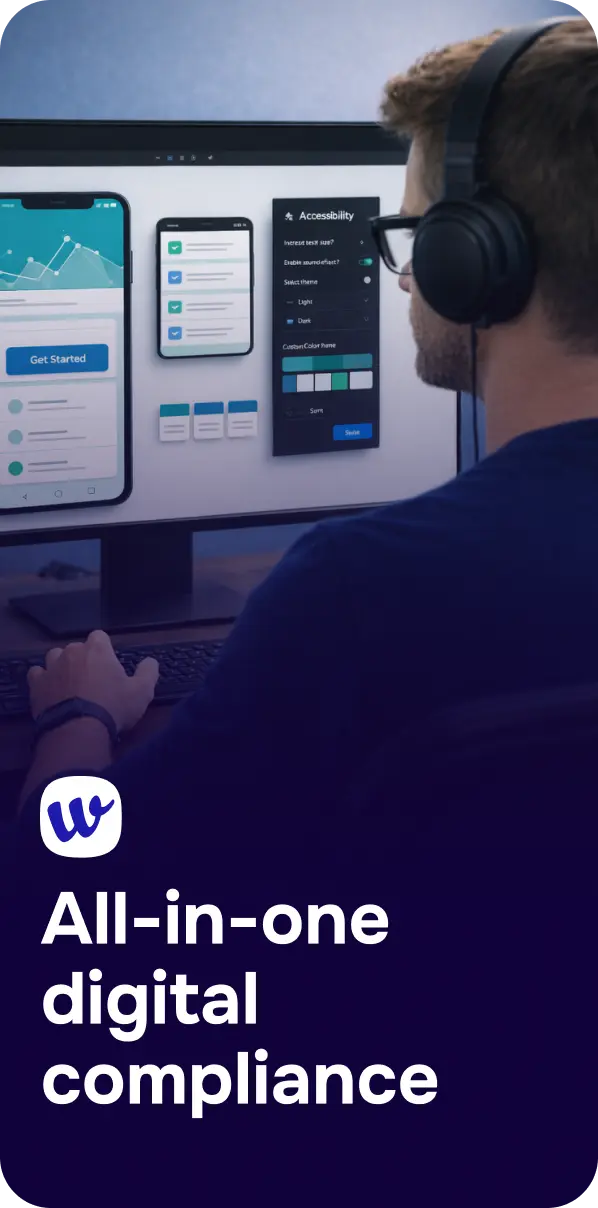
Digital transformation in government promises faster services, lower costs, and more transparent public administration. But when online portals, mobile apps, and digital forms are not accessible, that transformation leaves people behind—often the people who rely most on public services.
Inclusive digital transformation means every resident can perceive, understand, navigate, and use government digital services regardless of disability, age, language, device, or environment. In practice, that means building to recognized standards like the Web Content Accessibility Guidelines (WCAG), designing with real users in mind, and maintaining accessibility over time—because a one-time fix won’t survive constant content and feature updates.
Government services are not optional. They include healthcare enrollment, taxes, unemployment benefits, voter information, permits, education portals, emergency alerts, and more. When those services are inaccessible, the impact is immediate: missed deadlines, lost benefits, privacy risks from needing help, and reduced trust in institutions.
Accessibility is also essential for people in temporary or situational limitations—like a broken arm, bright sunlight, noisy environments, low bandwidth, or older devices. In other words, accessible design improves usability for everyone while especially supporting people who use assistive technology such as screen readers, screen magnifiers, switch devices, speech input, and captions.
Many jurisdictions require public-sector websites and apps to meet accessibility standards, commonly mapping to WCAG 2.1 AA (and increasingly WCAG 2.2). Failing to comply can lead to complaints, legal action, reputational harm, and costly rework.
However, compliance should not be treated as a checklist at the end of a project. It’s a lifecycle commitment: planning, design, development, testing, content publishing, and ongoing monitoring. This is especially important as governments adopt AI-driven chat, digital identity, and self-service workflows where a single barrier can block completion.
Inclusive transformation is measurable and actionable. It’s not about a single tool or a single team—it’s about building accessibility into the operating model.
Start by defining a target standard for all digital services and documents. WCAG provides testable success criteria focused on four principles: Perceivable, Operable, Understandable, and Robust. A practical approach includes:
Governments looking globally can learn from public commitments to inclusive digital economies, such as Zimbabwe’s reaffirmed commitment at WSIS Forum 2026, where digital inclusion is positioned as core economic infrastructure.
Citizens come to government sites to complete tasks—apply, pay, renew, report, register—not to “browse.” Inclusive design focuses on end-to-end journeys. Common failure points include:
Inclusive design practices that work well in government include consistent page layouts, clear headings, plain language, visible focus states, sufficient color contrast, and error messages that identify the field and the fix.

Government digital transformation often relies on third-party platforms: content management systems, appointment booking, payment gateways, identity verification, mapping, and customer relationship tools. If procurement does not include accessibility requirements, agencies inherit inaccessible components that are difficult (or contractually impossible) to fix.
Practical procurement steps include:
Accessibility isn’t unique to government; high-compliance industries face similar pressures. For example, the approaches outlined in digital accessibility for banks translate well to public-sector authentication, payments, and sensitive user data workflows.
Automated testing is excellent for catching recurring issues at scale—missing alt text, form label gaps, color contrast failures, and structural problems. But automation cannot fully validate user experience issues like confusing focus order, unclear instructions, poor error recovery, or whether alternative text is meaningful.
A strong testing model includes:
Platforms such as Corpowid (corpowid.ai) can help public-sector teams run automated accessibility audits and continuous monitoring across large website portfolios, making it easier to spot regressions after content or design updates.

Some organizations try to shortcut accessibility by adding an overlay/widget. While certain tools can improve usability for some users, overlays do not replace accessible code, proper semantics, or WCAG-conformant design. An overlay can’t reliably fix a broken form label, restructure headings, or correct complex interactions built without accessibility in mind.
If your accessibility approach is “we’ll add a widget later,” it’s a sign accessibility has been outsourced instead of operationalized. For a deeper look at why this matters, see Accessibility Overlays Are Not Enough: What WCAG Compliance Really Takes.
An accessibility statement is more than a compliance page. It’s a communication tool that should:
Corpowid (corpowid.ai) supports generating and maintaining accessibility statements tied to audit findings, which helps teams keep public commitments aligned with actual remediation work.
Accessibility strengthens other government priorities: economic participation, education access, disaster readiness, and equitable healthcare. It also intersects with sustainability and resilience. Digital inclusion can be viewed as part of climate adaptation and emergency preparedness—especially when essential information must be accessible under stress. That’s why frameworks connecting accessibility with broader impact, like accessibility as climate action, are increasingly relevant to public-sector digital strategies.
If you’re modernizing legacy portals or launching new services, these high-impact areas reduce barriers quickly:
These priorities are universal; they also show up in other complex customer journeys, such as in digital accessibility for the automotive industry, where multi-step processes and interactive components create similar accessibility risks.

To make inclusion real, governments can adopt a phased approach:
Digital transformation succeeds when it reduces friction for every resident—not only for the “average” user. Building to WCAG, validating with real testing, and maintaining accessibility over time turns inclusion from a slogan into a service standard.
Corpowid has been recognized by Gartner, a leading global research and advisory firm, for our innovation and performance in digital accessibility. These badges reflect our commitment to creating inclusive, AI-powered web experiences.








 TR
TR