For decades, the Americans with Disabilities Act (ADA) was primarily associated with the physical campus—the installation of ramps, widened doorways, and accessible restrooms. However, as the academic and administrative heart of higher education has migrated to the digital realm, the definition of "access" has fundamentally shifted. Today, a university’s digital presence—its websites, student portals, mobile apps, and course materials—is legally considered a "program or activity" that must be accessible to all.
In April 2024, the Department of Justice (DOJ) issued a landmark final rule that ends years of ambiguity regarding digital accessibility requirements. This rule establishes firm technical standards and strict compliance deadlines that will change how educational institutions manage their digital ecosystems forever.
The DOJ's new requirements under Title II of the ADA are not suggestions; they are mandatory legal benchmarks with specific timelines based on the population size an entity serves.
April 24, 2026: This is the primary deadline for state and local government entities, including large state universities and community college districts, that serve a population of 50,000 or more people.
April 26, 2027: Smaller institutions, special districts, and jurisdictions serving fewer than 50,000 people have an additional year to reach compliance.
While a year or two may seem like a generous window, the reality of achieving full accessibility across a sprawling university network is a massive undertaking. From departmental blogs to complex registration systems, the sheer volume of content is often staggering. Procrastination is no longer a viable strategy, as the technical debt of inaccessible content continues to grow with every new PDF uploaded or page published.
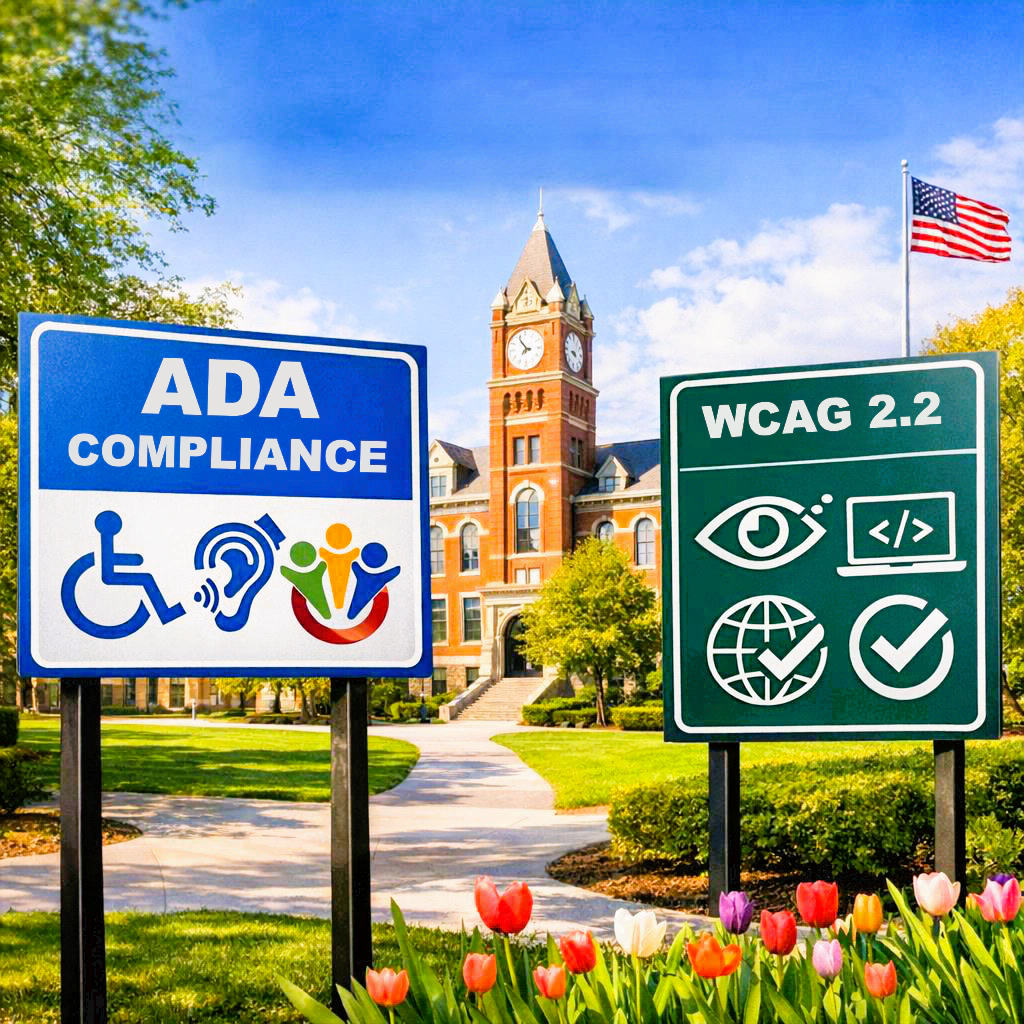
The DOJ has officially adopted the Web Content Accessibility Guidelines (WCAG) 2.1, Level AA as the technical standard for compliance. Developed by the W3C, these guidelines ensure digital content is usable for everyone, including those who rely on assistive technologies like screen readers or keyboard navigation.
The guidelines are built upon four fundamental "POUR" principles:
Perceivable: Users must be able to perceive the information. This means providing text alternatives for images, captions for videos, and ensuring high color contrast.
Operable: The interface must be functional for all. Users should be able to navigate via keyboard, control moving content, and have enough time to interact without forced timeouts.
Understandable: Information and operation must be easy to grasp. This includes using clear, plain language and ensuring navigation remains consistent across the site.
Robust: Content must be compatible with current and future assistive technologies, such as text-to-braille translators or voice-command software.
The new rule clarifies that university accessibility responsibilities extend far beyond the front-facing homepage. In fact, nearly every digital touchpoint a student, faculty member, or the public interacts with is covered:
Websites and Web Apps: This includes departmental sites, enrollment portals, and interactive campus maps.
Mobile Applications: Any official university app, from campus safety notifications to grade-checking tools, must meet accessibility requirements.
Electronic Documents: Perhaps the most significant challenge for universities is the thousands of PDFs, Word documents, and spreadsheets hosted on their servers. These must be remediated to be readable by screen readers.
Course Content: While there are limited exceptions for certain archived materials, the overall push is toward ensuring all modern educational technology (EdTech) is inclusive.
Third-Party and SaaS Tools: If your university uses a third-party platform—like a learning management system or a payment portal—the institution remains responsible for ensuring that tool is accessible.
Ignoring these deadlines exposes an institution to significant risk. In the U.S., roughly one in four adults has a disability. When digital barriers exist, these individuals are effectively denied the "equal opportunity" to benefit from government-funded programs.
DOJ Enforcement: The Department of Justice can launch investigations based on complaints. Enforcement often leads to mandatory settlement stipulations, which are often more expensive and disruptive than proactive remediation.
Private Lawsuits: Unlike DOJ complaints, private lawsuits can be filed directly in federal court. Legal fees, court costs, and the rush to remediate under a court order can be financially devastating.
The "Overlay" Trap: Many institutions are tempted by "quick-fix" accessibility overlays—widgets that claim to make a site compliant instantly. These tools often fail to fix underlying code, can actually create new barriers for screen reader users, and offer no reliable legal protection.
Achieving true accessibility requires a systemic approach rather than a one-time fix. It involves everything from the initial design of a page to the final PDF download.
Inventory Your Assets: You cannot fix what you don't know exists. Catalog every website, mobile app, and document library.
Audit with Experts: Automated tools are a great start, but they often miss 60–70% of issues. A robust audit must combine automated scans with manual expert review and testing by people with disabilities.
Establish Governance: Update procurement policies to ensure any new software or service purchased meets WCAG 2.1 standards.
Remediate the Core: Focus on high-traffic areas and essential services first, such as admissions, financial aid, and core student portals.
At Corpowid, we believe accessibility isn't just a checkbox; it's a pillar of modern usability and equity. As a U.S.-based company, we specialize in helping institutions navigate the complexities of the ADA and international standards.
Our approach is comprehensive, moving beyond simple fixes to provide a 360-degree accessibility service:
Design-Phase Integration: We work with your creative teams to ensure accessibility is baked into your digital assets from the very first wireframe, preventing costly rework later.
Web & Mobile Mastery: Our experts perform deep-dive audits and remediation for complex university portals and mobile applications to ensure they meet the 2026 deadline.
Document & Printable Remediation: We help you tackle the "PDF mountain," converting legacy course materials and administrative documents into fully accessible formats.
Search-Friendly Accessibility: We ensure your accessibility updates also boost your SEO, making your institution more discoverable to everyone.
The clock is running. Whether you are a large state university facing the 2026 deadline or a smaller district planning for 2027, the time to audit and remediate is now.
Would you like us to conduct a preliminary accessibility scan of your university’s primary domain? use https://corpowid.ai/.
The ADA Title II deadline extension may look like extra time, but for many public entities it mainly shifts pressure rather than removing it. Here’s why waiting can increase accessibility risk and what teams should prioritize now.
A year into the European Accessibility Act, businesses are moving from theory to operational readiness. Here’s what enforcement has actually looked like, where teams are getting caught out, and how to build a stronger accessibility process.
Corpowid has been recognized by Gartner, a leading global research and advisory firm, for our innovation and performance in digital accessibility. These badges reflect our commitment to creating inclusive, AI-powered web experiences.








 TR
TR