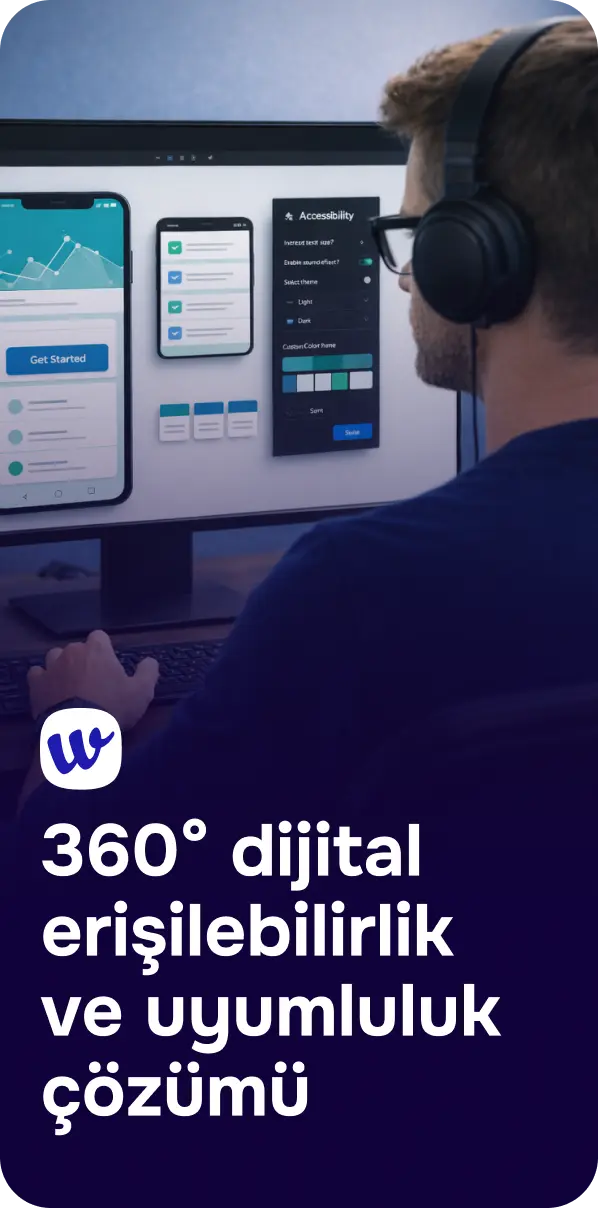
When a buyer says “send us your accessibility conformance report,” that should be a deal you close — not one you lose. Corpowid produces credible, audit-backed VPAT® 2.5 reports and ACRs for Section 508, EN 301 549 (EU/EAA) and WCAG 2.2 — tested by hand, written to be defensible. Every report is built on hands-on accessibility testing and delivered as complete accessibility documentation your procurement team can defend.
Get VPAT Quote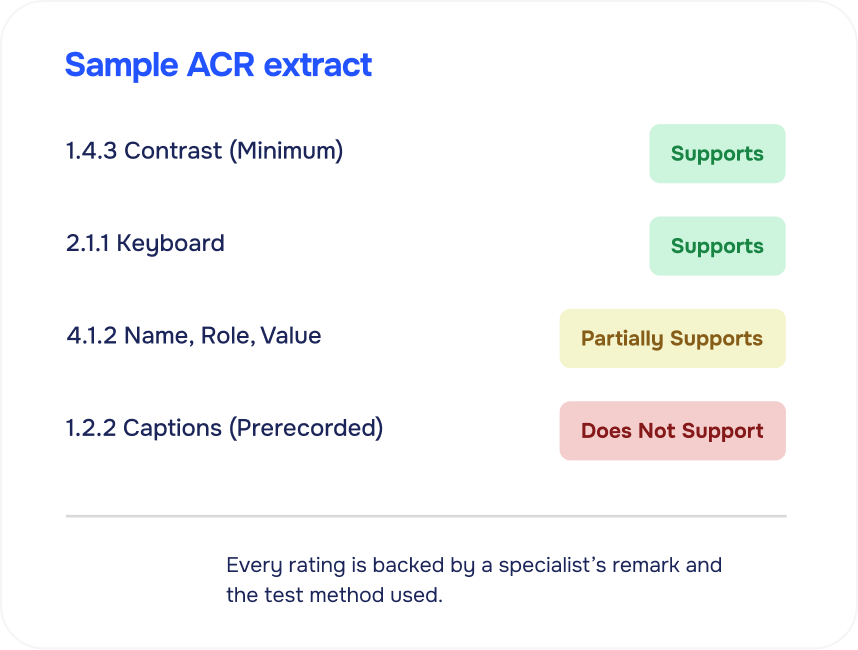
The VPAT® (Voluntary Product Accessibility Template) is the standardized template published by the Information Technology Industry Council (ITI). Once a specialist completes it for your product, the finished document is an Accessibility Conformance Report (ACR). Buyers ask for a “VPAT”; what they evaluate in procurement is the ACR — and a weak one fails the deal as surely as no report at all.

We author on the live VPAT 2.5 (ITI’s 2.5Rev) format. Older 2.3 / 2.4 reports are increasingly rejected by procurement teams.
Scanners catch roughly a third of issues. Conformance claims need a human with a screen reader — so that’s how we test.
Supports, Partially Supports, Does Not Support, Not Applicable — each with a defensible, criterion-level remark.
It comes down to one question: who is your buyer, and what standard does their procurement reference? Pick a tab — we’ll match the edition to the deal.
Required to sell to US federal agencies and any entity that receives federal funds — including most public universities and K-12 districts. Adds the functional-performance tables organized by disability category that the Revised Section 508 standards demand. Read about the ADA Title III →
Maps to EN 301 549, the standard referenced by the European Accessibility Act — in force since 28 June 2025. If you sell digital products or services to European buyers, this is the disclosure they expect. Read about the EAA →
The most flexible edition and the right default for private-sector and SaaS products in markets that simply reference WCAG. Covers WCAG 2.2, 2.1 and 2.0 (also published as ISO/IEC 40500). If your buyer hasn’t named an edition, start here. Read about the WCAG→
Combines WCAG, Section 508 and EN 301 549 in a single report. The right call when your buyers span US federal, EU public sector and commercial markets and you’d rather maintain one document than three. The most comprehensive — and the longest.
A credible Accessibility Conformance Report (ACR report) doesn’t just say “compliant.” It clearly states a rating for every applicable success criterion, with a remark explaining why. Whether you are working with a VPAT consultant or using a professional VPAT report service, these details are essential for transparency and trust.
An experienced VPAT provider ensures that the evaluation is accurate and defensible. Inflating these ratings is the fastest way to fail a sophisticated buyer’s review—especially when enterprises carefully examine every VPAT report service output before making procurement decisions.

The difference between an ACR report that closes deals and one that gets rejected depends on expert evaluation—best ensured by a trusted VPAT consultant or VPAT provider.
Tell us the product and the standard your buyer needs. We agree the screens, page types and platforms in scope on a short call, then fix the price and timeline.
Our VPAT testing process combines specialist manual checks — screen readers and keyboard-only navigation across your in-scope flows — with automated coverage. This accessibility testing is what turns a template into a defensible report, not the other way around.
We complete the right VPAT 2.5 edition, rating every applicable criterion with a clear, defensible remark and the evaluation method used.
A second specialist reviews the report for accuracy and tone before it carries the Corpowid name. You receive a buyer-ready ACR (and a plain-English findings summary).
Products change, and a stale ACR is a liability. An optional annual refresh keeps your report current as you ship — and as standards move.
No surprise hourly bills. We scope your product, give you a fixed price up front, and deliver a buyer-ready ACR. Anchors below — final price depends on the screens and platforms in scope.
One product, one standard.
INT edition — all three standards.
Your ACR shows exactly what’s failing. From there it’s a clear path — take each step with us or your own team.
VPAT & ACR questions, answered
A VPAT is the blank template from ITI. Once a specialist completes it for your product, the finished document is the Accessibility Conformance Report (ACR). Buyers say “VPAT,” but what they evaluate is the ACR.
Match it to your buyer: 508 for US federal and federally-funded buyers, EU (EN 301 549) for European customers under the EAA, WCAG for most commercial and SaaS buyers, and INT when you sell into all of them and want one report.
The current VPAT 2.5 (ITI’s 2.5Rev), aligned to WCAG 2.2, the Revised Section 508 standards and the latest EN 301 549. Older 2.3 / 2.4 reports are increasingly rejected in procurement.
Both — but the conformance claims are based on manual testing with screen readers and keyboard navigation. Automation gives coverage; it doesn’t produce a defensible rating on its own.
A typical single-product ACR is delivered two to three weeks after scoping, depending on size and the number of screens in scope. Rush timelines are available when a deal is waiting.
No — be wary of anyone who promises that. An ACR is an honest, evidence-based disclosure that demonstrates good faith and unblocks procurement. It isn’t a legal shield or a substitute for fixing real barriers.
A VPAT typically costs from around $1,900 for a single-edition report (508, EU, or WCAG) and from $3,200 for an INT edition covering all three standards. The final price depends on scope — the number of screens, page types, and platforms tested. Corpowid scopes your product on a short call and fixes the price up front, so there are no surprise hourly bills. Be cautious of "VPATs" priced like a template download: a credible, audit-backed ACR requires real manual testing, and that's what buyers actually evaluate.
A typical single-product VPAT/ACR is delivered two to three weeks after scoping, depending on the size of the product and the number of screens in scope. Larger or multi-platform products take longer because every applicable success criterion is tested by hand. Rush timelines are available when a deal is waiting on the report.
Technically anyone can fill out the VPAT template, but a credible ACR should be written by accessibility specialists who test the product manually with screen readers and keyboard navigation. Sophisticated procurement reviewers can spot a self-authored, inflated report — and an unconvincing ACR fails a deal as surely as no report at all. Corpowid's reports are authored by specialists and reviewed by a second specialist before they ship.
A VPAT is not itself a law — the "V" stands for Voluntary. However, the standards behind it are mandatory in many markets: Section 508 governs US federal procurement, the European Accessibility Act (EAA, in force since 28 June 2025) references EN 301 549, and the ADA and Title II rules drive WCAG conformance in the US. In practice, a VPAT/ACR has become the de facto requirement to sell to government, education, healthcare, and enterprise buyers, even when no single statute names the document by name.
VPAT 2.5 (ITI's 2.5Rev) is the current version of the Voluntary Product Accessibility Template, maintained by the Information Technology Industry Council and aligned to WCAG 2.2, the Revised Section 508 standards, and the latest EN 301 549. It's published in four editions — Section 508, EU, WCAG, and INT — so you can match the report to your buyer's market. Older 2.3 and 2.4 reports are increasingly rejected by procurement teams, so reports should be authored on 2.5.
WCAG (Web Content Accessibility Guidelines) is the technical standard — the actual rules a product is measured against, such as WCAG 2.2 Level AA. A VPAT is the reporting template used to document how your product conforms to those rules, criterion by criterion. Put simply: WCAG is the yardstick, and the VPAT (once completed, your ACR) is the report that shows how your product measures up.
AI and automated scanners can help draft a VPAT and catch issues quickly, but they find only about 30% of accessibility problems on their own. Conformance ratings — Supports, Partially Supports, Does Not Support, Not Applicable — require a human testing with a screen reader and keyboard, so an auto-generated PDF with no manual testing behind it won't hold up in a serious procurement review. The right approach uses automation for coverage and expert manual testing to produce defensible, criterion-level claims.
Yes — if a startup sells software or digital services to government, education, healthcare, or enterprise buyers, procurement will ask for a VPAT regardless of company size. Many early-stage companies lose otherwise-closeable deals simply because they can't produce a credible ACR when asked. Getting a VPAT early turns "send us your accessibility conformance report" from a blocker into a deal you close.
A VPAT/ACR documents conformance at a single point in time, so it should be updated whenever your product changes materially, whenever the relevant standard moves, and at minimum once a year. A stale ACR is a liability in procurement — buyers may treat outdated claims as inaccurate ones. Corpowid offers an optional annual refresh (with monitoring) so your report stays audit-ready for the next RFP.
Corpowid, dijital erişilebilirlik alanındaki yenilikçi yaklaşımı ve performansı nedeniyle dünyanın önde gelen araştırma ve danışmanlık şirketlerinden biri olan Gartner tarafından takdir edilmiştir. Bu rozetler, yapay zeka destekli ve kapsayıcı web deneyimleri oluşturma konusundaki kararlılığımızı yansıtmaktadır.








 EN
EN