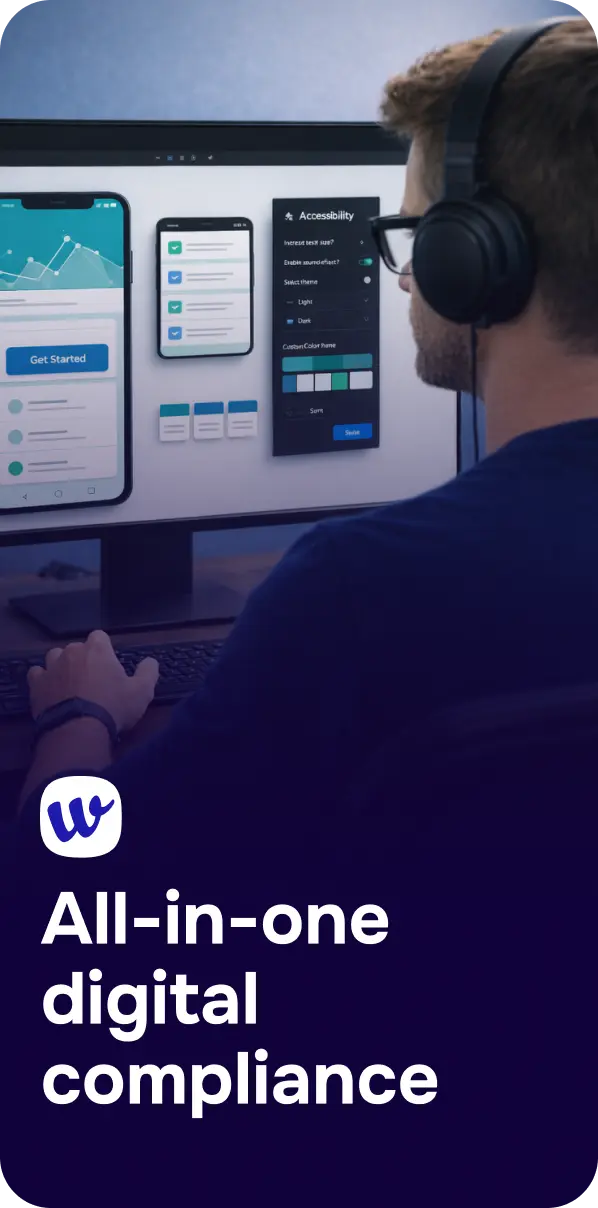
If we want Digital Equity—services that truly include everyone—accessibility can’t be a nice‑to‑have. It’s foundational to Digital Transformation, SEO, growth, and compliance. Yet the data shows the web is still falling short:
There’s another problem: teams who think they’re accessible (because they installed an overlay/widget) but still ship experiences that aren’t usable with screen readers or keyboards. Research—including peer‑reviewed work—shows overlays can conflict with assistive tech and even make sites less accessible for blind/low‑vision users. [dl.acm.org], [create.uw.edu], [coloradovi...ibrary.org]
Bottom line: Accessibility is about reaching everyone—and most websites aren’t there yet. We need developer‑grade audits and code‑level fixes, not just cosmetics.
Let’s be honest: overlays/widgets can be useful for user preferences (contrast toggle, text size, language, profiles), and Corpowid’s Accessibility widget is robust—20+ features, ~50 languages, profiles, custom modes, etc. That’s great for inclusion and quick wins.
However, widgets don’t fix your source code. Multiple studies find overlays rarely remediate structural issues (semantics, keyboard operability, focus order, alt text quality, ARIA misuse) and can clash with screen readers, leading to abandonment. [dl.acm.org], [create.uw.edu], [coloradovi...ibrary.org]
Even Google Lighthouse will confirm obvious misses (e.g., missing alt attributes, color contrast), but automated tools can’t judge context or task completion and won’t guarantee WCAG conformance on their own. [developer.chrome.com], [boia.org]
Conclusion: Widgets enhance usability, but Accessibility AI audit + code remediation is the real lever for Web accessibility and Search engine optimisation (SEO).
You can (and should) use standard scanners—Lighthouse, PageSpeed Insights, Axe, WAVE—to catch low‑hanging fruit. Lighthouse’s accessibility score is useful, but it only tests machine‑detectable rules and can’t validate human usability or context (e.g., whether Alternative text truly describes the image). [developer.chrome.com], [accessibil...y-test.org], [boia.org]
Performance matters too: PageSpeed Insights exposes Core Web Vitals (LCP, INP, CLS) that impact SEO rankings and user engagement; speed and accessibility often improve together when you fix semantics, reduce reflows, and optimize assets. [developers...google.com], [ahrefs.com]
Try this now (free): Corpowid’s scanner www.scanandfix — no registration, no fee. Run an AI scan to see your Accessibility AI audit scores and issue list. (Then move to code changes; remember, widgets are not enough.)
Regulatory pressure is real:
If you manage dozens or hundreds of pages, you need a tool that continuously crawls, flags WCAG warnings, and gives developer‑friendly reports—not just a one‑time score. (This is precisely where Corpowid Web Audit steps in.)
Example A—Keyboard operability:
WCAG 2.1.1 Keyboard requires all functionality be available via keyboard (no mouse required). If an element only responds to onclick and has no keyboard handler or is unfocusable, it fails. The spec’s intent: ensure pointer actions have a keyboard equivalent (critical for blind and motor‑impaired users).
MDN and other guides reinforce best practices (semantic controls, logical focus, avoiding positive tabindex, handling Enter/Space, no keyboard traps). [w3.org] [developer....ozilla.org]
Example B—Images without alternative text:
Missing or poor Alt text / Alternative description is still rampant. WebAIM data shows this is among the most common errors; many homepages have significant portions of images without meaningful alt.
W3C/WAI and WebAIM provide the technique: write image description that conveys purpose and context—not just “picture.” This helps screen readers and SEO. [webaim.org], [horlix.com] [w3.org], [webaim.org]
As a developer: You need exact page, DOM element, code line, and fix guidance—and you need to rescan after deploying changes to confirm the remediation.
Corpowid Web Audit automatically scans your website, detects Digital Accessibility issues page by page, code by code, and pinpoints the exact element and location (with tutorials on how to fix). You can rescan anytime, track your scores, and monitor trends via a powerful dashboard. As a developer, you get actionable, WCAG‑mapped findings rather than generic tips—so you can fix quickly and confidently.
Pair this with Corpowid’s widget for user preferences, but rely on Web Audit for Accessibility software‑grade detection and AI scan guidance. When you fix the reported issues, your site becomes more accessible, more inclusive, and more SEO friendly.
Ready to see where you stand?
Run a free scan: www.scanandfix (no login).
Then upgrade to Corpowid Web Audit for continuous AI audit, WCAG mapping, element‑level reports, fix tutorials, and rescans on demand. Ship true Web accessibility with developer‑grade confidence—and unlock SEO and Digital Transformation wins.
Try it now: www.scanandfix — start your Accessibility AI audit and make your site inclusive, operable, and WCAG‑aligned.
The ADA Title II deadline extension may look like extra time, but for many public entities it mainly shifts pressure rather than removing it. Here’s why waiting can increase accessibility risk and what teams should prioritize now.
A year into the European Accessibility Act, businesses are moving from theory to operational readiness. Here’s what enforcement has actually looked like, where teams are getting caught out, and how to build a stronger accessibility process.
Corpowid has been recognized by Gartner, a leading global research and advisory firm, for our innovation and performance in digital accessibility. These badges reflect our commitment to creating inclusive, AI-powered web experiences.





 TR
TR